
2012:1
Poems by Stig Dagerman and fiction by Lotta Lotass and Kjell Westö.
Editor: Sarah Death
Reviews Editor: Anna Paterson
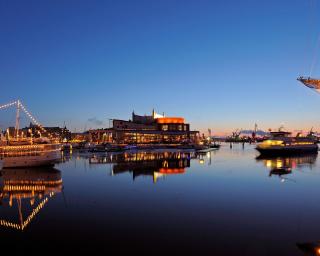
(Image: Gothenburg harbour, December 2011. Credit: Göran Assner/imagebank.sweden.se)
A recent New Yorker cartoon reflects on what some Anglophone writers have to contend with while Nordic fiction remains in vogue: a publisher looks disparagingly at a submission and says to its hapless author: ‘Can’t you make it Swedish?’ Meanwhile, Edith Grossman in her Why Translation Matters (Yale University Press, 2010) cites ‘one of my favorite cartoons, in which a bewildered translator asks a disgruntled author, “Do you not be happy with me as the translator of the books of you?”’
The majority of literary translators currently active in our circles do not, thankfully, give their authors such cause for alarm. It is good to see the translator’s importance more widely acknowledged and discussed these days than it has been for quite some time. The award of the 2011 Nobel Prize in Literature to Tomas Tranströmer did much to keep the spotlight trained on the profession: an article in Svenska Dagbladet, ‘Tranströmer now in 54 languages’, incorporated interviews with his translators into Dutch, Japanese, Polish, Romanian, Czech and Slovak.
In this issue of SBR we launch a new, occasional series called Translator’s Choice, in which established literary translators are invited to translate and introduce texts that particularly appeal to them. Our first contributor is Laurie Thompson, who has chosen a selection of Stig Dagerman’s ‘daily verses’ from the 1940s and 1950s. In fact, all the translations in this issue look back to the past. Kristina Sandberg’s Giving Birth is an achingly told tale of a young woman contending with class prejudice and unplanned pregnancy in 1938. Kjell Westö’s Don’t Go Out Alone Into the Night is set in the 1960s, as the generation born in 1939-45 seeks its place in a rapidly modernising Finland. In While Others Were Celebrating Victory Jens Orback gives a moving account of helping his German mother start to come to terms with scarring experiences at the close of the Second World War.
An impressive reviews section offers a great range of books for non-Swedish publishers looking for potential winners to back. Remember that translators are busy these days and need to be booked in good time! 2012 is Strindberg centenary year, and SBR will mark this with a themed autumn issue. Strindberg scholars around the world will be hoping to shed new light on the man and his writing, and there is no better way to do that than by translating or retranslating his work.
Translations
TRANSLATED EXTRACT
Satirical Poems by Stig Dagerman
A selection of Stig Dagerman’s ‘daily verses’ from the 1940s and 1950s.
Translated by Laurie Thompson

TRANSLATED EXTRACT
from Don't Go Out Alone Into the Night by Kjell Westö
The fourth in a quartet of novels set against the backdrop of 20th-century Helsinki. Translated by Paul O'Mahony
Articles

FEATURE
Lotta Lotass: Experimental Author of Fiction and Drama
Eric Dickens looks at how one author tests the limits of experimentation and readability.
Reviews
Edited and curated by Anna Paterson
REVIEW
Siri
Much has been written and said about Strindberg and his attitude to women, but not many books have been written from the point of view of his women.

REVIEW
Grand final i skojarbranschen
The blurb speaks of ‘a hilarious play on the idea of autofiction’ – and so it is. The story about the famous writer Lillemor Troj is closely based on Kerstin Lillemor Ekman’s own literary career.

REVIEW
Outsider
At the end of the 20th century, traditional student privilege is being eroded and success is no longer guaranteed.
REVIEW
Wrestlarna
Four individual narratives wind through the cold, technologically-mediated world of today’s youth.
REVIEW
Belägring
The reader eavesdrops on a nocturnal phone conversation with a friend, in which the events of the day slowly unfold.

REVIEW
The Agency Semolina Pritchard Ltd
The Agency of the title is a London theatre agency, run by a larger-than-life character called Semolina Pritchard.
REVIEW
Minnet av en smutsig ängel
Although Mankell is best known for his crime novels starring Inspector Kurt Wallander, he also writes many other kinds of books, including novels about Africa. This one explores the nature and legacy of European colonialism.
REVIEW
Himmel över London
A witty, metafictional confection combining a thriller plot with many other strands.

REVIEW
Det goda inom dig
Everything about Linda Olsson’s writing is permeated by nature, gentleness, longing and loving. She makes it personal, drawing you slowly but inevitably into her story, so that you care about the characters, as if they were your own kin.

REVIEW
Snöängel
A captivating, complex novel: Palm paints beautiful images of wintry Stockholm and arouses a palpable impression of the 1980s.

REVIEW
Causa Mortis
Palm concentrates on an area he knows very well: the work of a pathologist specialising in crime victims.

REVIEW
Röd snö
The author is insightful about the quirky by-ways of the mind, knows a lot about science and in particular about viruses.

REVIEW
Den girige
An original and humorous novel capturing not only quintessentially Swedish, but also very western phenomena of modern life.
REVIEW
Välkommen till den här världen:
The colon in the title ushers the reader into this world, the world of the beautiful but socially inept, and a world made up of triangles.
Poetry

REVIEW
Flodtid
Continues Frostenson’s weaving together of ideas, use of contradictory images, transformations and unpredictable leaps that have made her one of Sweden’s most revered poets.
Fiction for children and teenagers

REVIEW
Konstiga djur
This is a nicely illustrated book with funny, colloquial prose, mostly in the form of dialogue. In a charming way it demonstrates that we are all more or less strange.

REVIEW
Pojkarna
This is a novel about gender. It is about coming to terms with the fact that in our society you are sorted into the ‘not powerful’ category of people if you happen to have a female body.
Non-fiction

REVIEW
Europas skam. Rasister på frammarsch
A comprehensive study of the rise of right-wing extremism in Europe by a knowledgeable and brave journalist.
REVIEW
Ordens asyl
In our current civilisation almost defined by personal mobility, how should one define a writer in exile?