
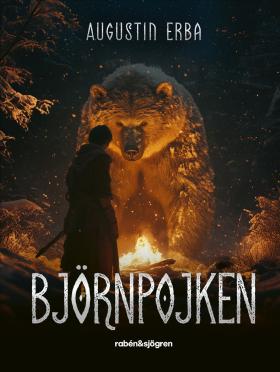
Björnpojken
(The Boy and the Bear)
by Augustin Erba
reviewed by Ann-Marie Einhaus
Björnpojken (The Boy and the Bear), a historical novel aimed at young readers, tracks a young Arab boy’s journey from captivity in Sweden back to Baghdad. Its coming-of-age character arc and travel plot make Björnpojken a worthwhile and engaging read for young readers as well as their parents. I would like to note at the outset, though, that the bear of the title does not play quite as big a part as I had expected, although it does play a crucial role for plot development in the first quarter of the book. This might come as a disappointment to some, but if, like me, you get anxious about animal friendships that clearly have to end in separation, you might feel reassured by this information. Without spoiling the plot, I can say that boy and bear part on excellent terms and each pursues his life, with the bear getting to be the wild animal he is.
Having got my bear-related caveat out of the way, I return to the broader story. Rashid, an eleven-year-old boy from Baghdad, is both the protagonist and the narrator of the novel. At the outset, we find him cold and dissatisfied in temporary quarters near the Volga, where he has travelled with his father, the Arab travel writer and diplomat Ahmad Ibn Fadlan. Ibn Fadlan was a real historical person, whose embassy to the Volga Bulgars in the late tenth century gave him the chance to observe the Volga Vikings, too. His travelogue is the most detailed written eyewitness account we have of Viking habits and customs, and yet we know little enough about Ibn Fadlan himself that his travelling with a son is just about possible, though for the sake of his plot Erba has edited out the entourage with which an embassy from the Abbasid Caliphate would have travelled. Rashid, unhappy with his father’s absorption in his work, goes exploring om his own, which unfortunately gives a band of homeward-bound Vikings the chance to capture him, unaware of his background and the fact that he might command a ransom. In what follows, Rashid has to face the kinds of hardships one would expect for someone carried off into enslavement: cold, hunger, violence and loneliness, not least because nobody speaks his language.
Starting off as a somewhat spoilt child, Rashid has to mature rapidly, and his development into a more independent, confident teenager happens gradually. He meets friends as well as many enemies along the way, and his contempt for the rough customs of his captors compared to the warmth and ease of life in Baghdad gradually gives way to an understanding that each culture has its strengths. By the end of the novel and an unexpected (but, in hindsight, amply foreshadowed) plot twist regarding Rashid’s true identity, he is shaping up to be an open-minded explorer in his own right. He has had to learn independence and understand his place in the world the hard way, and has come out on the other side a stronger and more compassionate young person.
The main character’s development was, to me, the most attractive aspect of Björnpojken. But besides being a novel about a young boy’s personal growth through adversity, Björnpojken is also a timely novel about intercultural encounters and the value of understanding ourselves and others. Unlike his Viking captors, Rashid has enjoyed a thorough cosmopolitan education, including various foreign languages, but his lack of Norse leaves him feeling desperate to communicate until he meets a kindly traveller with knowledge of Arabic. As he learns his new friend’s language and finds out more about Nordic culture, Rashid recognises how much the ability to communicate is tied to being accepted – more so, in fact, than looks.
At the same time, while Rashid understandably considers the Caliphate of Baghdad as far superior to Viking society in terms of courtesy and comforts, he also comes to realise that his own people in turn oppress and enslave others, not least via his encounter with an Egyptian girl whose people are under Abbasid rule. Nice additional touches are the historically accurate inclusion of a powerful female Viking leader (even though she isn’t exactly one of the nice characters), and the way the novel conveys just how far and wide people travelled in the name of trade back in the tenth century. An episode involving mythical Sinbad the Sailor, on the other hand, felt a little forced, and I would have liked a bit more detail on actual travel, since the several sea voyages Rashid takes are largely skirted over. However, this is a children’s book, and my small quibbles are those of an adult. I know that my eleven-year-old self would have enjoyed Björnpojken hugely.

Björnpojken
Raben & Sjögren, 2025, 182 pages
Foreign rights: the author
Augustin Erba is a novelist, essayist and dramatist writing for both adults and younger readers.