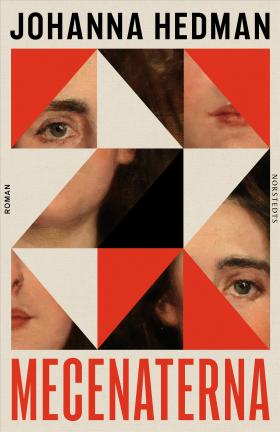
Mecenaterna
(The Benefactors)
by Johanna Hedman
reviewed by Stevie Preater
Who does art belong to, is art just a commodity like any other, and has the idea of the free artist always been a myth? This clever novel may raise more questions than it answers, but its cutting observations of people and social dynamics will chime with anybody interested in cultural life.
Alma and Maud met in a mouldy London house share back in their wild twenties and became friends. Now Alma has chosen a conventional Stockholm life with mortgage, husband and baby. She rebels against this in small ways, while also dreaming of a larger house with even more perfect furnishings. Meanwhile, Maud has become somewhat of a success in the art world, with fans clamouring to meet her and stare at her paintings for hours on end.
Hedman’s debut book, Trion (The Trio) also touched on the theme of a so-called cultural elite and the actual elite, with power and money. This subject is further developed in Mecenaterna (The Benefactors), though if you enjoyed The Trio for its portrayal of sexuality and unconventional relationships, you won’t find that here. This book is more measured, and its characters are no longer on the cusp of adulthood. Alma and Maud feel that they have moved from being regarded as possibilities to being either failures or successes. Reaching 35 and being settled in life is described as both a triumph and a sorrow.
The premise of the story is Maud’s disappearance and Alma’s search for her, through which we hear from several characters whose lives have intersected with Maud’s in some way. We discover some crumbs about Maud from these first-person voices, though we may be reticent to trust them all. Having the reader understand Maud only through the words of others is an interesting concept; Hedman allows a brief view into different worlds, before whisking us away again, the only constant being Alma, whose chapters push the plot forward.
The gallery owner who manages Maud’s art is driven by a need to protect her benefactors’ investment. Alma has previously worked for this gallery as some kind of snake-charmer for investors, stroking their egos and losing her romantic notions of art in the process. Alma is described as feeling like a prostitute in these encounters, yet also retains some sense of moral superiority to the magpie-like benefactors, who are drawn to glittering things with dreams of achieving immortality. She learns to assess the size of their wallets and the extent of their fear of being forgotten after death. Patronising the arts is their way of leaving a mark.
In perhaps the strongest section of the book, we are privy to the thoughts of art collectors. These provide a witty critique of an art world which prizes monetary value over artistic worth. Who are these benefactors? We meet many: a rich man who gathers artists for Italian summer sojourns but seems to despise them, a bored upper-class woman, a housing developer taking intravenous infusions of youthful blood to slow his own aging, a German couple, a Parisian curator, a banker, a Saudi prince. There are some genuinely funny, sharp observations here, written with a confident style: for example the tech bro whose smartwatch marks the passing of time by the steady increase in unread emails, and who thinks of unestablished artists as ‘living startups’.
Another interesting theme is the age-old dilemma of whether female artists must protect their solitude or can have a family without destroying their ability to make art. Cyril Connolly wrote in 1938 that ’There is no more sombre enemy of good art than the pram in the hallway’ – it is a shame that almost 90 years later the debate continues, even in a country with such generous provision for childcare as Sweden, but Hedman undeniably expresses fears shared by many female creatives. Maud receives conflicting advice from other women, some of whom tell her that art can coexist with marriage and children, while others are clear that this would lead to disaster.
This book plays with rumours and untruths, as well as reputation and public image. It’s an interesting point that in Swedish the concepts of rumour and reputation can both be covered by the same word: ‘rykte’. The two flow into and from each other, feeding Maud’s mystique and market value. Added to this is the supernatural element of Maud’s art. The practice of ‘slow looking’ at art has gained in popularity in recent years, with Tate recommending 10 minutes. Maud’s paintings entice viewers to longer reveries, though if this is a real phenomenon or some kind of PR-trick is unclear. Whether she’s a fraud or a genius is largely irrelevant for the benefactors, just so long as she doesn’t turn up again with a barrage of new paintings and flood the market. The importance of scarcity in inflating value is captured succinctly when Hedman writes that the best thing an artist can do for their art is to die. Though her benefactors might welcome that outcome, the reader can only hope that Maud and Alma can find a way to take control of their own narratives and lives.

Mecenaterna
Norstedts, 2025, 272 pages
Foreign rights: Norstedts Agency
Johanna Hedman’s debut Trion (The Trio) from 2021 has been widely praised, translated into 6 languages (including into English by Kira Josefsson) and optioned for a TV series set for release in 2026.