
2011:1
Fiction by Sigrid Combüchen, Jonas Karlsson and Hannele Mikaela Taivassalo, and an interview with Henrik Berggren
Editor: Sarah Death
Reviews Editor: Anna Paterson
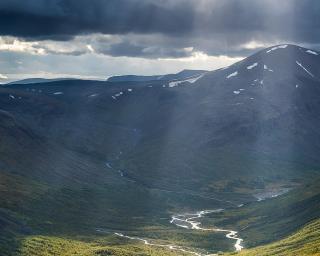
(Image: Rapa Valley, Sarek National Park. © Fredrik Schlyter/Imagebank.sweden.se)
At SBR we work a lot with people in the business of seeking publicity and exposure for their national literatures. One sought-after route these days is to be chosen as the focus country, or geographical area, at a major book fair. A whole continent, Africa, was in that coveted position at last autumn’s Gothenburg Book Fair and Swedish publishers, especially small independents, significantly boosted the number of titles they published from Africa as a result (Source: Svensk bokhandel). It is impossible to gauge the benefits precisely, of course, but everyone is keen to seize the opportunity. ‘Les lettres nordiques à l’honneur!’ announces the website of the Salon du Livre in Paris this spring, offering a fine array of authors assembled by the Nordic countries, and Finland is investing serious time and money, including gearing up translators of Finland-Swedish, as it prepares to be the focus country at the Frankfurt Book Fair in 2014.
Then there is the positive effect of being a prizewinner: this brings an inevitable boost to sales, and to visibility, even internationally. SBR and publications like it always make sure to list any prizes a book has won. Are we prize–obsessed in the modern publishing world? Of course we are, but if everyone’s a prizewinner, how then to judge new fiction for translation?
Who can publishers consult? Not many can justify the cost of employing scouts. Some may ask translators: a few translators have the ear of individual publishers; a larger number act as readers. Agents are major players in the Nordic field now, for good or ill. But some publishers might say the whole point is the thrill of making their own discoveries. We remind our readership that SBR is an independent voice. Publishers looking for advice that is not profit-led publicity department hype can find here not only tasters and articles but also reviews written by a panel of contributors who can read Swedish, many of whom work as publishers’ readers.
In this issue we also offer extracts from Waste, which won the 2010 August Prize for Sigrid Combüchen, who has featured in our pages for many years. There are two newer authors to discover, as well as an interview with Henrik Berggren on his new biography of Olof Palme, a man whose fate fascinates beyond borders. Our reporters bring you their impressions of the 2010 Gothenburg Book Fair, fortunately unaffected by volcanic ash clouds or other problems besetting similar events around the world.
Translations
TRANSLATED EXTRACT
from Waste by Sigrid Combüchen
Winner of the 2010 August Prize, Sigrid Combüchen's Waste is a story within a story, a narrative with many layers and multiple time sequences, full of empathy, humor, irony, social criticism and literary finesse.
Translated by Linda Schenck

TRANSLATED STORY
The Commission by Jonas Karlsson
Taken from Jonas Karlsson’s second volume of short stories, this is an intriguing and somewhat disconcerting tale of an artist unwittingly unearthing some murky secrets.
Translated by Darcy Hurford
TRANSLATED EXTRACT
from Oh, Come and Look at This by Hannele Mikaela Taivassalo
On one level a time-travelling murder mystery, on another a meditation on travel, home and rootlessness, Hannele Mikaela Taivassalo’s haunting novel defies standard categorisation.
Translated by Sarah Death
Articles

INTERVIEW
The intellectual, the individual and the state
Anna Paterson interviews Henrik Berggren on Underbara dagar framför oss, his account of Olof Palme and his times.
Reviews
Edited and compiled by Anna Paterson
Novels and short story collections
REVIEW
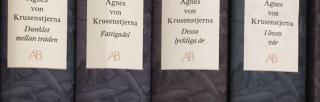
Fattigadel
Agnes von Krusenstjerna's tetralogy charting the decline of an entire class is republished.
REVIEW
Flugtämjaren
An historical novel about Johan Ludvig Runeberg, the Finnish national poet of the nineteenth century. With such a topic most readers would expect quite a serious approach. However, this novel was written by Erik Wahlstöm – and that makes all the difference.
REVIEW
Den drunknade
Therese Bohman's chilling, atmospheric debut plumbs the darker depths of relationships.
REVIEW
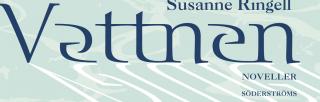
Vattnen
Finland-Swedish writer Susanne Ringell’s collection of short stories provide tantalising glimpses into hidden lives, as when glinting fish dart by.
REVIEW
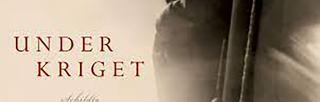
Under kriget
Carola Sandbacka’s historical novel focuses on the often neglected details of everyday life during the Winter War between Finland and the Soviet Union.
REVIEW
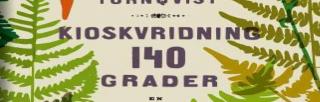
Kioskvridning 140 grader
Peter Törnqvist's first novel is an intellectual and urban work speculating upon the world from oblique and baroque angles.
REVIEW
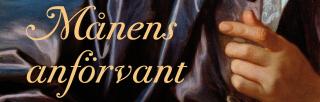
Darling River: Doloresvariationer
Sara Stridsberg's novel engages in an interesting way with its source material: Nabokov's Dolores Haze (Lolita).
REVIEW
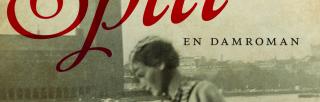
Spill. En damroman
Sigrid Combüchen has finally won the prestigious August Prize for this cleverly composed work delving into the details of a ladies’ novel without plunging into the chicklit category.
REVIEW
Kolka
Bengt Ohlsson bids us believe that our contemporary psychology can shape the future of individuals, as happens in this novel.
Crime fiction

REVIEW
Döda poeter skriver inte kriminalromaner
Björn Larsson's satire on the Scandinavian crime fiction wave abounds with meta-fictional allusions.
REVIEW
Den döende detektiven
Leif GW Persson's crime novel draws on his deep knowledge of the Swedish legal system and police procedure.
REVIEW
Kvinnan utan egenskaper
Niklas Ekdal, like Stieg Larsson, has a background in journalism; and, like Larsson, he uses the thriller genre to criticise aspects of Sweden’s recent history.
Non-fiction
REVIEW
Språket är Gud. Anteckningar om Joseph Brodsky
Professor of Slavonic Studies and translator Bengt Jangfeldt's vänbok (notes in remembrance) and portrait of the poet Joseph Brodsky.
REVIEW
Underbara dagar framför oss. En biografi över Olof Palme
A quote from Henrik Berggren explains the drive behind this biography: ‘Checking the newspaper cuttings about Palme, I realised I had found a source referring to much of the history of the twentieth century.’
Books for children and young adults