
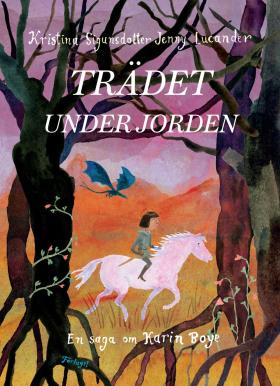
Trädet under jorden: En saga om Karin Boye
(The Underground Tree: A Story about Karin Boye)
by Kristina Sigunsdotter and Jenny Lucander
reviewed by Elizabeth Lutz
This impressive collaboration between Kristina Sigunsdotter and Jenny Lucander imagines Karin Boye as a child. The story take place when Karin is eight years old in 1908, just before the Boye family moves from Gothenburg to Stockholm. Karin’s childhood is filled with legends and fairy tales. Her father reads versions of the classic stories to his children after dinner. The nurserymaid tells Karin fantastic tales, including the story of a seer. While playing hide and seek at Vasaparken, Karin finds a pearl inside a tree and follows it underground to another world. She has to deliver the pearl to its owner, the Nameless Princess, and return to the tree within seven days before it disappears—and with it, the portal back to her own world. One of the first people she meets underground is the seer, who gives her a warning: ‘beware the Forest of Sleep’. This is part of a haunting refrain that is repeated throughout the story. Karin also meets others who help her in her quest: Bang, a figure based on the journalist Barbro ‘Bang’ Alving (and not unlike the Moomin character Snufkin in appearance), a ghost pirate, and Maryl in The City of Truth. The Nameless Princess ‘did not look at all like the princesses in story books’. She’s thin and fragile and wears glasses. Like Alice in Wonderland, it’s unclear where reality ends and the dream begins. The Princess accompanies Karin back to her world, but is changed into a bird.
Although the story is dedicated first and foremost to Karin Boye, readers do not need to know about her life and work to enjoy the narrative. The underground world may be Karin’s escape from the real world, but it is not a paradise. There are still evils and dangers to face there. In this way, it’s similar to Nangijala, the world in Astrid Lindgren’s The Brothers Lionheart. While in the real world, Karin has problems in her home life, in the underground world she has to fight a dragon and rescue the Nameless Princess from the Wolf. Karin is an inspiring female lead who narrates her own story and has incredible agency. She takes on the traditional male role of saving the princess. Bang cuts her hair, gives her a suit of armour to wear, and a horse to ride. She’s given a sword by the ghost pirate. He tells her it’s broken, but that shouldn’t matter as she won’t be battling any dragons. Karin responds: ‘That is perhaps exactly what I’ll do’. The one point in the story she loses her way is in the Forest of Sleep, where she encounters a woman motionless on the forest floor. The Forest and the vision of Karin’s future self are allusions to the depression Karin Boye struggled with all her life. Any readers with some background knowledge of Boye’s biography will also recognise the connection between the Wolf and Nazism, the link between The City of Truth and Kallocain, and the Nameless Princess as a tribute to Boye’s German partner, Margot Hanel. A short explanation is provided at the end of the book along with Boye’s poem ’Kunde jag följa dig’ (If I Could Follow You).
In the spirit of Boye’s most famous poem ‘I rörelse’ (‘On The Move’), Karin is always on the move. The illustrations are so full of motion that they are almost like animated sequences as she sails over the glass sea with a pirate, rides a horse, flies with eagles, runs from soldiers, and fights a dragon. The soft edges and rich colour palette in Lucander’s watercolour illustrations contribute to the dream-like quality of the underground world. The way Lucander depicts Karin conveys her courage while revealing her vulnerability. She’s small and thin, with twig-like arms and legs, even when dressed in armour. Her facial expression is determined, with wide-open eyes intent on the goal.
At times directly citing from Boye’s poems and at times only alluding to them, themes found in her work form an undercurrent to the story. In one moment of happiness at the Lake of Dreams, where dreams cling to everything like invisible spider webs, Karin christens the Nameless Princess Tiiu. Sigunsdotter’s text is written in poetry. She employs poetical techniques like alliteration, simile, metaphor, and parallel structure, delighting readers with the sound of words and their flow. Her descriptions evoke all the senses. Wind from the sea is ‘strong, salty, and sunny’. The mountain teems with soldiers like ‘worms in an old cheese’.
More than 80 years after her death, four of Boye’s poems have been included in the Swedish Academy’s recent poetry collections for children, showing that her work can and should be enjoyed by young people. Trädet under jorden introduces Karin Boye to a young audience through an imaginative tale. The book is a good companion to Sigunsdotter’s previous book for children about Edith Södergran, Landet som icke är (The Land That Is Not), illustrated by Clara Dackenberg. These books interpret the work of two of the most influential poets of the twentieth century writing in Swedish. It’s encouraging to see their work reaching contemporary audiences through the medium of children’s books.

Trädet under jorden: En saga om Karin Boye
Förlaget, Finland, 2025, 80 pages
Rights: Koja Agency
Kristina Sigunsdotter is a writer, artist, and playwright. Her previous books include the August Prize-winning Humlan Hanssons hemligheter (The Secrets of Cricket Karlsson) illustrated by Ester Eriksson and Landet som icke är (The Land That Is Not). She is a member of the Swedish Academy for Children’s Books.
Jenny Lucander has illustrated many books including Freja och huggormen (Freja and the Snake) by Fredrik Sonck, När farmor flög (My Flying Grandma) by Annika Sandelin, and Vi är lajon! (We Are Lions!) by Jens Mattsson, which won the 2020 Nordic Council Children and Young People’s Literature Prize. She lives in Helsinki.