
‘Theatre Can Serve a Social Purpose’
Isabel Cruz Liljegren on Bringing Drama into the Spotlight at Gothenburg Book Fair
interviewed and translated by Alex Fleming
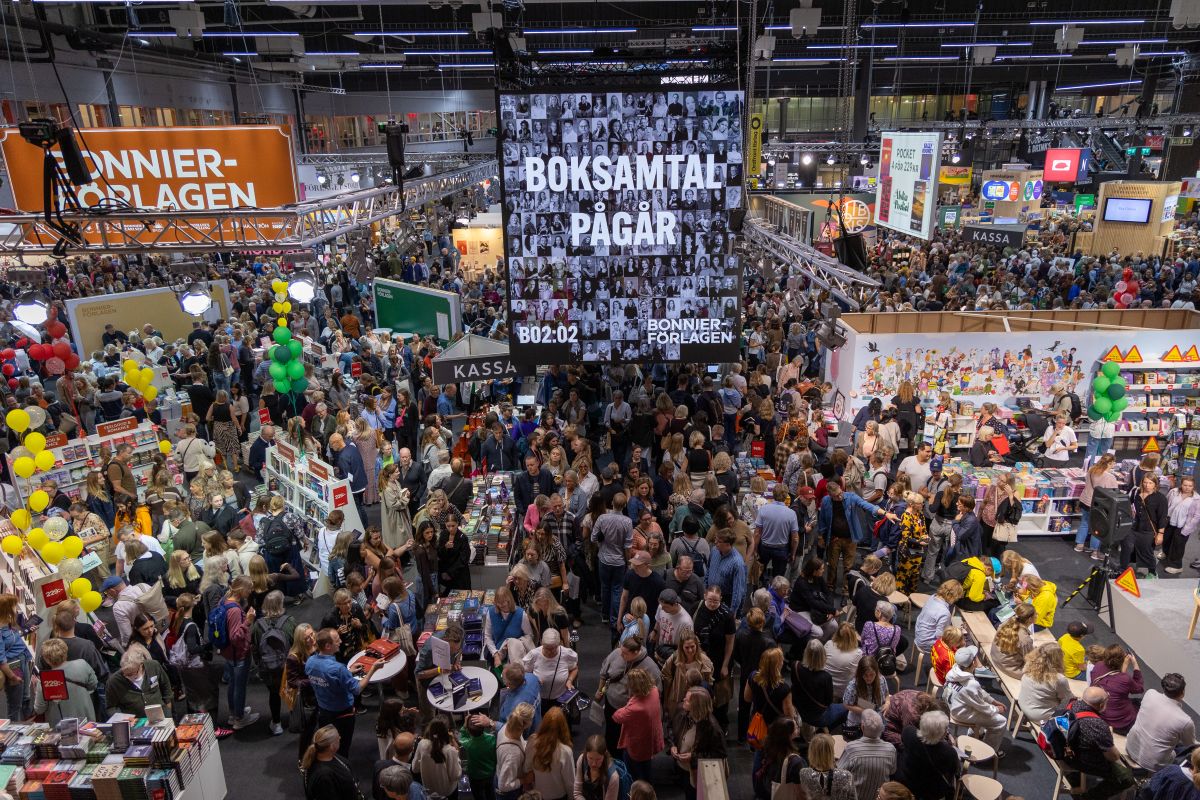
In 2025, drama reclaimed its rightful position at the heart of Sweden’s literary scene when it was highlighted as one of the themes at Gothenburg Book Fair, Sweden’s primary publishing event. For four days thousands of visitors were treated to a wide variety of readings, panels and ‘drama slams’, as participants explored the possibilities of contemporary drama and its role in grappling with the most fundamental of human questions.
One of the driving forces behind this project was Hedda Krausz Sjögren, CEO of Sweden’s Colombine Teaterförlag. Alongside a group of Nordic and Baltic partners, she developed a fair programme that brought drama – and those that produce it – back into the spotlight.
Some months after the conclusion of the fair, Swedish Book Review spoke to Hedda Krausz Sjögren and two programme participants, playwright Isabel Cruz Liljegren and dramaturg Marc Mathiessen, to take stock of the project and its impact. In this series of interviews, the interviewees discuss their work, burgeoning public interest in the dramatic arts, and the future of theatre in Sweden.
SBR: How did you become involved in the Drama focus at Bokmässan? How natural did it feel to bring drama into the bookfair space, and what did you draw from it as a participant?
Isabel Cruz Liljegren: I’m involved in several organisations and contexts (the Writers Guild of Sweden, Theatre Magazine and Colombine Teaterförlag, to name a few) that work in a variety of ways to promote recent Swedish drama, so me joining the project was fairly organic. I’d thought that we playwrights would be overshadowed by the literary writers, banished to the dark corners and nooks of the fair, but it was the reverse: I felt that we were really well received, with respect and curiosity, from pretty much everyone at the fair.
The drama that I most value is drama that is close and present, that takes risks and sets things in motion – within the room and each viewer alike.
Can you tell us a bit about your approach to playwriting? How would you describe your work?
My plays move through multiple genres and themes, but they often take place in the liminal spaces between reality and fiction. As an artist I’m drawn to what’s hidden and concealed, to points of friction and rupture. One artistic approach that I always find myself coming back to is formulated in Georges Bataille’s essay collection Literature and Evil. In it he describes how humanity is guided by two contradictory forces: the will to live and protect our lives, and the urge to live as intensely as we can. This conflict, according to Bataille, is one that only art can transcend. Through art we can increase the intensity of our lives, without putting our actual lives at risk.
In my art I explore complex, charged themes such as death, sexuality and identity. I strive to create drama that touches people, provokes political reflection and paves the way for philosophical enquiry – often with playful, humoristic elements. The genres I feel most at home in are those that reach the greatest and deepest emotional registers with a lightness of touch. I happily work with mocumentaries, thrillers or musicals. The drama that I most value is drama that is close and present, that takes risks and sets things in motion – within the room and each viewer alike. With any luck, that motion will continue long after the performance has ended, with an impact on society or on one individual’s life.
Your plays have been staged in some of Sweden’s most important theatres. From your experience, what do you feel are the greatest challenges now facing drama, and what areas are thriving?
People are interested in theatre, and with the spread of insecurity and political disillusionment within society public engagement is on the rise. I feel that people right now are searching for meaning, depth and spirituality, and it’s in that that theatre can serve a social purpose. That’s why theatre should stop trying to reproduce film and literature and instead, through new drama, continue to explore what makes it unique, and find new ways of communicating with and approaching its audience.
[Theatre should] continue to explore what makes it unique, and find new ways of communicating with and approaching its audience.
I am interested in drama’s various states, and how these are present in the writing process. When you are writing, do you conceive of your work as a piece of text, or as a piece to be performed? How do you attend to these different possibilities?
Drama is always a text that is written to be spoken. I write dream worlds into existence, textual worlds that seek to communicate with and reach others through language. It is through rhythm, musicality, subtext and poetry – and occasionally through characters’ motivations – that I create my work. I rarely write with a notion of how a text should be directed, or an image in my head of how the staging might look.
Occasionally I create texts for a production concept, and in those instances the texts can reside in a place of greater uncertainty or be more fragmentary, since I know how the production will supplement it – when I’m directing it myself, that is. The nature of the work is different when text and production are being created together, or in parallel, and I like both ways of working. I also enjoy meeting actors early on in the process, so that I can shape the text in a way that suits or is in dialogue with them as individuals and their strengths. Without actors there is no theatre. I often fall in love with actors.

Isabel Cruz Liljegren
Isabel Cruz Liljegren is a playwright, director and dramaturg. She has written over twenty-five plays and pieces of musical theatre, including for Kulturhuset Stadsteatern, Gothenburg City Theatre, National Swedish Touring Theatre, Folkteatern Göteborg and Swedish Radio. She is also co-artistic director for the dramatic arts group Hi! Art.