
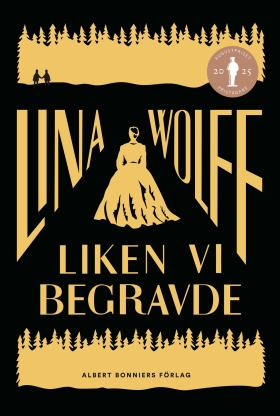
Liken vi begravde
(The Corpses We Planted)
by Lina Wolff
reviewed by Emma Olsson
Lina Wolff is an outspoken fan of the late Chilean writer Roberto Bolaño – she’s even credited reading him with her decision to become a writer. I thought about this recently while reading a short story by Bolaño called ’Anne Moore’s Life’ (translated from the Spanish by Chris Andrews). True to its title, it follows the life of a free-spirited and restless woman named Anne Moore from the perspective of a friend. At the very start of the story, when she is just ten years old, Anne glimpses ’for the first time what she would later call the ashen (or the dirty) face of reality’ when her older sister’s boyfriend kills his parents in their small suburban town. The matter is only discussed briefly, but the sense of darkness evoked by that one line is strong enough to define the entire story. Sometimes, one act of darkness is all that is needed to define a story. To define a life.
I kept thinking of this line from Bolaño when reading Liken vi begravde (The Corpses We Planted). The ashen face of reality can be seen from all angles in this novel.
The novel follows sisters Jolly and Peggy, growing up as foster children in a small town deep in ‘darkest Skåne,’ a deprived place known for ‘perverts and paedophiles living in every bush.’ The town seems to breed depravity. Peggy, the older sister, sets her sights on cosmopolitan Lund or Copenhagen, determined to leave the madness behind. Jolly, our narrator, is less occupied by dreams of escape. Her role is that of the witness, the fated storyteller.
Just as in Bolaño’s story, it is a murder that sets the tone of Jolly and Peggy’s. When young twin girls are found brutally murdered in the town, something fundamental seems to crack in their foster mother, for whom the crime becomes a lifelong obsession. The murder lives on like a ghost, a never-ending reminder of all that is wrong with the town.
But the murdered twins are not the only ghosts. Also haunting the town is the ‘authoress,’ a nineteenth-century writer who was born and raised there. Her existence – the proof that someone from a town with perverts and paedophiles lurking in every bush could become a famous writer – becomes a lifeline for Peggy. The authoress is an invigorating spirit, albeit a tragic one. She ended up taking her own life, alone in a hotel room in Copenhagen.
These two spirits, the twins and the authoress, are perfect symbols of the town’s duality. A podunk town where citizens get drunk on cheap vodka and violence is the norm can also be a place that breeds writers and great storytellers – not only in the form of accomplished authors, like the authoress, but in the everyday eloquence and humour found in the rich Skånska spoken by its inhabitants. This is also what makes the story feel so personal to Wolff, who grew up in a town not unlike this one, and whose novels make poetry of the absurd.
Reading Corpses as a fan of Wolff’s work is a book-lover’s joy. I would regularly stop and nod my head, gaining a richer understanding of her authorship with each page. The book is littered with delightful Easter eggs. We see Bolaño, her hero, appear in the village in the shape of two Chilean refugees who come to live with Peggy and Jolly. The real-life Swedish author Victoria Benedictsson, hailing from Wolff’s hometown of Hörby in central Skåne, appears in the form of the authoress. The murdered girls in the story made a previous appearance in Wolff’s 2022 novel, The Devil’s Grip, and they show up in her own life as well. In 1989, the murder of ten-year-old Helén Nilsson in Hörby shocked Sweden and put Wolff’s hometown in a spotlight bright enough to chase all its horrors from the shadows; to illuminate its ashen face.
These connections to Wolff’s own life are not only interesting biographical facts; they are the puzzle pieces assembling her life as a writer. Previous Wolff novels have taken us to Italy (The Devil’s Grip) and Spain (Carnality), places the writer has called home for a time, with references to her native Skåne making only brief appearances. Corpses breaks this personal history wide open. By going back to the beginning, to the place she came from, Wolff is telling us who she is and how she became a writer. The künstlerroman elements are as thrilling to read as the murders and acts of revenge (spoiler alert: the ’corpses’ being planted are not just metaphors). And with Wolff’s trademark humour, it all goes down smoothly like a shot of Swedish vodka.
Liken vi begravde
Albert Bonniers förlag 2025, 288 pages
Foreign rights: Winje Agency
Lina Wolff’s novels include Bret Easton Ellis and the Other Dogs (for which she won the Vi Magazine Literature Prize), Carnality (which won the Aftonbladet Literature Prize), and The Devil's Grip (nominated for the August Prize), all translated into multiple languages including English. She has won the August Prize twice, in 2016 with The Polyglot Lovers and again in 2025 with The Corpses We Planted.