
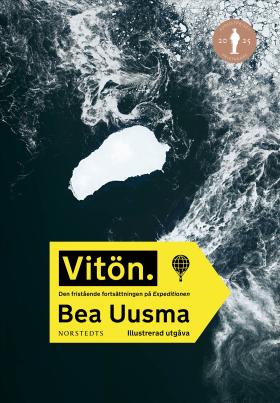
Vitön
(White island)
by Bea Uusma
reviewed by Kate Lambert
The book’s title means ‘White island’ and is the Swedish name for the Norwegian island of Kvitøya, part of the Svalbard archipelago, where the bodies of the three members of the Andrée expedition – Salomon August Andrée, Knut Frænkel and Nils Strindberg – were found 33 years after their death.
Vitön is a freestanding follow-up to Uusma’s 2013 book Expeditionen: Min kärlekshistoria, which was translated into English by Agnes Broomé as ‘The Expedition. A Love Story: Solving the Mystery of a Polar Tragedy’ in 2015. I have read Expeditionen, and have been intrigued by the expedition and its tragic, heroic daftness since studying Per Olof Sundman’s novel Ingenjör Andrées luftfärd at university, but this book recaps Andrée’s dream of gliding across the Arctic in the most modern vessel of the day and ‘the riddle’ of its fate sufficiently for new readers to be similarly gripped.
Uusma trained as a medical doctor and puts her forensic skills to good use in her continuing investigation into the men’s deaths, including whether even the correct skulls were matched to the correct bodies in 1930. She examines bones, has blood samples analysed and consults weapons experts about the state of their rifles. She sets up a search party to try to find the love letter to Anna Charlier that Nils Strindberg dropped from the balloon after take-off, and she brings in the latest forensic techniques to decipher the four and a half pages begun in Andrée’s second diary, which was not as well-preserved as the first. Each of these sections reads like a detective story, sometimes with nitpicking forensic detail. I especially like her deductive flowcharts.
Uusma is also an illustrator and her drawings of the positions of the bodies and the original location of all the objects taken from the site in 1930 are brilliant; the latter painstakingly reconstructed from contemporary transcripts. Their little boots and the location of their socks are touchingly human. The book is also packed with photographs old and new, showing the sheer scale of the island’s glacier and its arctic conditions.
Uusma’s log book of the attempted expedition to Kvitøya with nine experts and two dogs trained to find human bones is especially tense and gripping. She has sold her car, applied for grants, obtained permits and finally sold her house to finance it. Will they be able to land or will they be thwarted by ice conditions, weather, waves, and polar bears? Will the Norwegians let them distract the polar bears? (No). Could they perhaps drug the Norwegians? (Also no).
The book ends with a report on what Uusma knows so far, including a list of the finds from the island, a map of the camp, her answers to 16 questions about the evidence – Why are Strindberg’s and Frænkel’s guns in the boat, 12 metres from the tent? Why is the primus stove found beside Andrée up on the slope? – and a plausible course of events. But will we ever know for certain?
Vitön is not only a report of painstaking forensic research; it is also an emotionally absorbing memoir; the story of Uusma’s drive to discover the truth and of her self-awareness about her own obsession. ‘Why am I doing this?’ ‘I don’t know if I’m investigating the Andrée expedition because I’m alone or if I’m alone because I’m investigating the Andrée exhibition’. Finally, she returns the 1930s book about the expedition that she stole from a party in the 1990s and walks out into the new-fallen snow.

Vitön
Norstedts, 2025, 297 pages.
Foreign rights: Linda Altrov Berg, Norstedts Agency
Winner of the August Prize for Non-Fiction in 2025.
Bea Uusma’s first book on the Andrée expedition Expeditionen: Min Kärlekshistoria was also awarded the August Prize in 2013 and was reviewed in SBR 2014:1.