
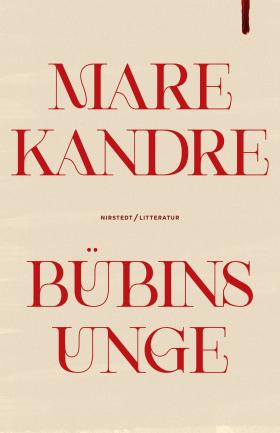
Bübins unge
(Bübin's Kid)
by Mare Kandre
reviewed by Darcy Hurford
In her introduction to this new edition of Bübins unge, the author Sara Stridsberg observes that there is something special about people that write who die too soon; ‘they always die a little more and a little less than everyone else’. Less, in that we can continue reading them. More, in that death silences two voices; the literary and the human one. Mare Kandre published eleven books during her lifetime, but there is no knowing what direction she might have taken had she lived longer.
What is clear though, is that her writing, particularly its tendency towards prose-poetry, exact language, and ability to mix high- and low-brow references (something less acceptable in the 1980s when she debuted than it is now), influenced and continues to influence others writing in Swedish today. Stridsberg counts herself among their number, and notes other names including Andrea Lundgren, Lina Wolff and Linda Boström Knausgård (to take those whose work is available in English translation). Kandre was an acclaimed author during her lifetime; calling her books modern classics feels uncontroversial.
Bübins unge (Bübin’s Kid) is a case in point. A fairly slim novel, divided into six sections, it has a list of characters so short and settings so limited it could almost be a chamber play. There is the narrator, a young girl entering puberty, there is Bübin, her mother, and they live with a man the narrator calls ‘Uncle’ who is her mother’s partner. There are a few people in the village. Later there is a younger sibling too: the dismissively named ‘Bübin’s Kid’ of the title. The story takes place in the garden or in the house, bar a short visit to the village. Something in this pared-downness, the simplicity of the setting and participants and the repetitions in the story are reminiscent of Jon Fosse.
The novel opens with a quote from Lewis Carroll’s Alice in Wonderland, with Alice (grown enormous after drinking from a bottle labelled DRINK ME) wondering what has happened to her and thinking someone should write a book about her. Like Alice, the narrator feels that she is growing and growing, but unlike Alice, there is ultimately no happy ending. Bübin and Uncle go away for a time, and return with a baby sister. Later they go away again, and do not return, leaving the two children alone together, which eventually has fatal consequences.
Admittedly this does not sound appealing as plots go. But the pull of Bübins unge is not really in its plot. It is in the atmosphere, which is fairly Gothic (think original Brothers Grimm) and highly evocative. The narrator spends a lot of time in the garden, and describes nature in a vivid way. The arrival of summer, for example, is phrased is very physical terms; you can almost feel the garden pulsating:
The trees belch out sweetness, flies; the earth is silent; the wind moves the bushes, the thick brambles, up from the grass, forces the junipers up against the walls.
The family backstory is only hinted at:
When Bübin first came up here from the village, selected by Uncle, she was still light and slender, with all the strength still in her body –
She made her way into everything; things that otherwise, in many ways, were hard and closed she lit from within.
The exact nature of Bübin and Uncle’s relationship is left to the reader to judge, as are many other parts of the story. Kandre’s prose is beautiful, if at times disturbing, and suggestive rather than straightforward. You might put down Bübins unge with part of you wondering what exactly it is you have read, but it is absorbing when you are in it. Mare Kandre is an author well worth discovering. For an overview of her work, this article by the late Eric Dickens is helpful reading.
Bübins unge
Nirstedt/Litteratur, 2025, 160 pages
Foreign rights: the publisher
Mare Kandre (1962–2005) mostly grew up in Gothenburg, Sweden, but spent six formative childhood years in Canada, which provided the background for her debut novel I ett annat land (In Another Country), published in 1984. Bübins unge was her third novel, originally published in 1987.