
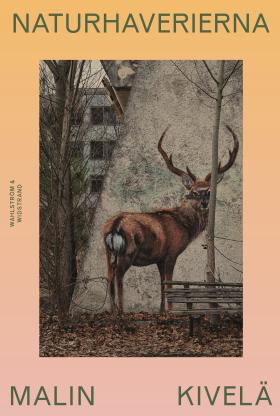
Naturhaverierna
(Nature Wreckers)
By Malin Kivelä
reviewed by Kathy Saranpa
How do humans stop wrecking the planet while maintaining the same standard of life? Or is this an impossible task? And what distinguishes humans from the rest of the so-called natural world? Malin Kivelä has written an extremely thoughtful and thought-provoking book that looks to thinkers across a broad spectrum to help her answer her questions. Her intent, as she says at the start, is to try to address nature and climate change without preaching or pointing fingers; however, people have been recycling, eating vegan and taking fewer trips for years now, but it is clearly not enough. She looks to a number of philosophers, nature-lovers, academics and writers to search for solutions.
And at times, Naturhaverierna (Nature Wreckers) feels like a review article in which the author connects one text with the next. The list of these writers itself is provocative – such diverse figures as Ted Kaczynski (the Unabomber), Henry David Thoreau, Donna Haraway – a heroine of ecofeminism – and other lesser-known figures, particularly those from Kivelä’s native Finland, are also given the stage.
Naturhaverierna begins as Kivelä travels to Poland on the trail of Simona Kossak. This woman was a biologist who moved to a cottage in the Białowieża forest, where she became friends with assorted animals, many of whom lived inside the house with her. A boar, an owl, a raven – these became her primary animal companions. Kivelä delves into books about her as well and is able to meet family members who tell anecdotes, but Kivelä never feels she succeeds in capturing her essence. Her search continues.
Back in Finland, Kivelä begins to read through and compile her many books and stacks of notes, including those about Kossak, to help her on her way. She ploughs through works by Henry David Thoreau, the Finnish naturalist Pentti Linkola and Ted Kaczynski. She puzzles over Donna Haraway, half-frustrated and half-inspired, and learns about rewilding, or the returning of urbanized spaces to their natural state, from Finnish journalist and author Riikka Kaihovaara. To take in all of these thoughts, she stays away from the rest of the family in their summer cabin, without electricity or running water, where she reflects on her relationship to the family cat as she considers the interdependency between the wild and the human.
One thing that strikes the reader is that there is no way to live in pure harmony with nature. As Kivelä points out, Thoreau actually lived only a mile from his mother, who, some sources report, did his laundry and brought him food. Kossak rode a moped to work and Haraway, an academic, belongs to that group so condemned by Kaczynski. As for Kivelä herself, she puts a tracker on her cat, feeds him non-vegan food packed in plastic and is revolted by the idea of emptying the outhouse containers. She mentions ‘comfort creep’, which refers to the human tendency to not want to give up a comfort once it’s been experienced.
Toward the end of the book there is a chapter on surfing, a rather startling turn. Kivelä waxes nearly poetic about a week spent pursuing this activity on the coast of Denmark. But it makes sense, since this is a way for a human being to place herself close to nature’s power and at the mercy of ocean waves. Although surfers wear neoprene and no longer use surfboards made of wood, Kivelä points out that these are people who spend most of their time waiting for the perfect wave. Is it not something like an animal’s life – not spent on five-year plans or market predictions, but rather in a state of calm observation, until it’s time to find food or fight off an attack?
Finally the author reveals her bout with cancer. This is one of the most fraught issues in the book: death is natural whereas many of the procedures to fend it off involve plastic, electricity, chemicals, and many disposable items. Should we try to stave off death, accept procedures and interventions, buy ourselves another few years? Linkola and Kaczynski believed that the weak deserved to die, that this was nature’s way. Perhaps the issue is simply unsolvable; as a friend of Kivelä told her, ‘If you speak about nature, you can never be right.’
Kivelä’s book is a banquet of thoughts. Her skill at distilling the works of such diverse voices with very different views and connecting them one to the other makes for a very accessible text on a very difficult issue. She provides no answers – perhaps there aren’t any – but her questions and her struggle to answer them make Nature Wreckers a must-read.
Naturhaverierna
Wahlström & Widstrand, 2025. 200 pages
Foreign rights: Rights & Brands
Malin Kivelä was awarded the 2026 Ingrid, Margit and Henrik Höijer Donation Fund prize for Naturhaverierna. Previously, she won the Svenska YLE Literature Prize in 2013 and 2019.
Her children’s book Om du möter en björn (If You Meet a Bear) was reviewed in SBR 2023:1.