
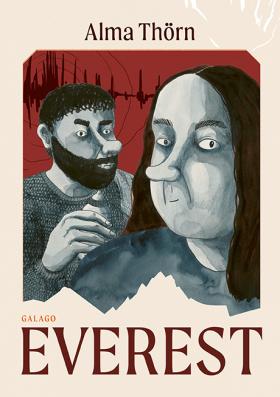
Everest
by Alma Thörn
Reviewed by B.J. Woodstein
Alma Thörn’s second graphic novel, Everest, is about Emma, a woman who seems to have it all – partner, children, a future in which she will work again – and yet who is dissatisfied and misunderstood. Her partner traipses off to his job each day, leaving her at home with the kids, while he enjoys his career and his friends. Emma feels undervalued and stuck, changing nappies, listening to prattle, playing games, doing laundry, seeing to housework, and otherwise making sure their home runs smoothly and their children are cared for. The repetitive nature of these necessary albeit tedious tasks is not engaging to Emma, but her partner seems to expect her to love every moment of her life, and doesn’t show much sympathy for her stress and boredom.
Then something manages to catch Emma’s attention: Everest. Perhaps it is the metaphor of life being an uphill struggle akin to climbing a mountain, or maybe it is a fascination with a person’s dedication to such an extreme task, or it could be an appreciation for the harsh beauty and danger of Everest, or some combination thereof, but Emma finds herself more and more fascinated. Soon, she’s constantly scrolling, searching, watching, doing everything she can to learn about trekking on Everest.
Emma begins to exercise again, a choice that improves her mental health, while also bringing an attractive new man into her life. She is not entirely honest with him about being partnered with kids, and she allows herself a flirtation that makes her feel attractive and wanted in a new way. Also, he is knowledgeable and she is able to use him. He helps her to get fit and plan for a trip to Everest, without being fully aware that that is what he is doing.
The interest in Everest and her goal of climbing it give Emma a new approach to her life and help her feel like more than a partner and mother. The denouement of the novel depicts Emma lying to her partner, abandoning her children, and flying to Everest, where she embarks on the climb of a lifetime. Whether this is just a fantasy or something she actually does is left open to interpretation, but the message is clear: she has to find herself again, and figure out a way of incorporating her own needs into her broader life.
Everest is a graphic novel with a careful eye for the details of a young mother’s life. Without even needing to read all the words, the reader sees Emma’s dark-underlined eyes, her racing brain, her impatience with her partner, her ennui at the mundanity of life with babies and toddlers, and then her excitement at finally having something of her own. The images are in primary colours and the reader’s attention is drawn to Emma’s expressive face. Her story feels universal and while not every downtrodden mother wants to literally climb a mountain, each of us has our own Everest.

Everest
Alma Thörn studied at the Umeå Art School and Comics School in Malmö. She previously published two children’s books (of which Onsdagar på badet, ‘Wednesdays at the Swimming Pool’, was reviewed by Maria Lassén-Seger in SBR 2024:1. The graphic novel Alltid hejdå (Always Goodbye) won the Norrland Literature Prize and was nominated for the August Prize.