'There’s still a real power in the idea of groups of cartoonists and political pamphleteers putting their views across'
Sofia Olsson, publisher, Galago förlag
Interviewed by Henning Koch
Swedish Book Review interviewed artist and publisher Sofia Olsson about Galago, the seasoned but ever-youthful and playful publisher of graphic novels and comic books.
When I was researching Galago, I saw that you have been interviewed quite often, and that Babel did a piece on you in 2023.
Yes, that was when Rolf Classon released Galagoboken (2023, trans. A Book About Galago).
Rolf, of course, was a founding member of Galago in the late 1970s. Do you think Sweden has been a bit of a trendsetter with graphic novels and cartoons?
Difficult to say, really. Galago was a magazine in the early days, very much in the zeitgeist of things, it was the 1980s, people were tired of empty slogans. Literature and poetry were being re-examined, people felt it was time to deal with empty slogans and pomposity. Galago offered photo reportage, cartoons, poetry, and so on, it was alternative culture. Which obviously existed also in other parts of the world, Galago was particularly influenced by American underground culture. There was a general tiredness with politically correct culture. There was real power in the underground, in the US it was stuff like Art Spiegelman’s Raw that inspired people here. I don’t know if there was anything particularly different about Swedish comic creators back then, but about 20 years ago there came a wave of new Feminist comic book creators. I don’t know if you could really say they were politically correct, but they produced a lot of highly entertaining material. Liv Strömquist and Nanna Johansson and Sarah Granér came out of the movement and I was also a part of that emerging group in Malmö, which is now more than 20 years ago. Galago and comic books were really hot at that time. It took a few years for this to spread internationally. Liv Strömquist was the one who really became massive.
Was there anything else that made this wave of Swedish comic book creators stand out?
I think there was a feeling of high quality about it. But since then, it’s become more difficult to predict trends in the physical book market. Right now, I’d say there are comparatively fewer books that are being released than there were 20 years ago.
You mean, released by Galago?
Yes, but also when you look at other publishers. Kartago publishers disappeared although it still exists as an imprint of Cobolt Publishing. There are fewer places to publish now if you’re an alternative comic book creator. Of course, we are commercial too, we’re a part of Ordfront förlag, a listed company, and obviously we’re here to make money. But we don’t do Marvel comics. We stick with high quality, which may sound a stupid thing to say… I mean, the idea of wanting to be a part of a non-commercial cartooning culture, but there it is.
Of course, we are commercial too, we’re a part of Ordfront förlag, a listed company, and obviously we’re here to make money. But we don’t do Marvel comics.
Actually, that’s really interesting, when a publisher attempts to define itself and gains an audience by being different. I was going to ask, this book by Moa Romanova that got so much attention, that was published by Kartago, right?
Yes, it was an imprint of Bonnier then.
It feels as if Kartago is still a part of Galago, even though it’s now hived off. You created it in the first place.
(Laughs) Yeah, sure. But we do still publish the magazine, which Fredrik Strömberg has called “the oldest comic book magazine still in circulation...” Galago magazine is essential as a platform for comic book creators, and you’ll find artists like Moa Romanova publishing there from time to time even though she doesn’t publish her books with Galago anymore… In the magazine we can give debutants a chance, obviously it’s a much bigger risk if you go ahead and publish a whole book by them.
Do you also publish digitally?
It has proven difficult to make money from e-publishing. Web comics can be big in certain genres, such as manga, it can be a way of making a living for cartoonists, putting out a page per week or so. But that’s a difficult option for us, we need subscribers. We send out our publications on paper, which, in my opinion, makes for better reading. Also, as a reader, if you’re looking at full-colour printed watercolour images, maybe you prefer to look at actual paper.
In a way you’ve avoided the problem, which is common to the Swedish experience, where publishers are losing market share to audio streamers. You publish your books on paper and you have your readers.
Yes, because obviously you can’t do comics as audio books. That would only work if you animated the content and turned it into films, which would be quite expensive. So in a sense it’s an advantage, because we don’t even have to think about the audio streamers. Of course it’s not easy making a profit from physical books either. And you can’t ignore the way the market works. The kick-back on audio books is not great. Readers get used to having masses of content for 200 SEK per month, which makes them less likely to walk into a bookshop to spend 300 SEK on a printed book. It has affected us in some ways, perhaps, but some people would probably suggest that the audio sector has broadened the offering and democratized literary content.
When Galago started you were underground and sort of punky, and the content was also quite male, but then more women got involved. Is that right, would you say?
That’s right. Galago started in the same month that I was born. When I look back at the early stuff I don’t feel quite as included as I do now, I don’t feel I could have got so involved in the early days. Having said that, Mats Jonsson and Johannes Kanell put in an incredible amount of effort, I mean they actually started counting our contributors, they decided it had to be 50/50, more or less. It gave results.
One does feel that Galago is a publisher that’s willing to take risks. One of the books that we’re featuring in SBR 2026:2 is A Year of Apocalyptic Thinking (Ett år av apokalyptiskt tänkande, reviewed in 2026:1 by B.J. Woodstein – and I think it’s fair to say that it’s a courageous book, it’s edgy, really edgy. Many publishers would have avoided it, there’s a lot of pain there. Although it’s also funny.
We did have some initial discussions with Linda Spåman. We were concerned that the book might be seen as an argument for assisted suicide – I mean, that we should have assisted suicide clinics in Sweden. The book has had a good reception, people have accepted this was how her father felt, and how Linda feels about it. Some diseases are too much to bear, it breaks people. If it hadn’t been a pictorial book I think it might have been interpreted more as a polemical work, an argument for assisted suicide. There’s something about pictures that can intensify and heighten certain aspects, but pictures can also be disarming. Linda Spåman is both a writer and a visual artist, she’s a renaissance person who does not shy away from pushing boundaries. The reader has a sense of there being a personal style at work here and a visual style that makes one examine the material in a unique way.
The other Galago release we’re featuring is Sanna Kullin’s graphic novel, Gothenburg Syndrome (Göteborgssyndromet). Readers who know the city will recognise many of the images in it. Which gives it a feeling of authenticity. Do you think that many Galago books are somehow specific to Swedish society? In translation would they still be as relevant or appealing to overseas readerships?
I mean, Sanna’s book is very much set in Gothenburg, it’s nice to feel that strong location. The title, obviously, is a play on “Stockholm syndrome” and the book shows how the narrator, a young woman, has in a certain sense been abducted and taken over by the kooky, impossible figure of Jack. That’s a completely universal story in any language. Gothenburg Syndrome has not yet been picked up internationally, and there may be a perception that it’s somehow specific to its location. In fact it’s a story that’s accessible to everyone, and it has sold very well in Sweden.
What does it take to sell a graphic novel or comic internationally?
In our experience, to do well in Europe the comic books often have to have a certain slickness in their style. For instance, Mats Jonsson, who was a big commercial success in Sweden, didn’t really gain as big an audience overseas, although his Hey Princess (Hey Princess) was translated and released in 2010 by American publisher Top Shelf. As a general rule, if the material is very Swedish or offbeat it has a harder time crossing into other markets. But yes, some of our books have done well, there are four international editions of Cecilia Vårhed’s Empty Brag (Fattigt skryt, extract published SBR 2024:2). Bim Eriksson’s Baby Blue (Baby blue) has also done well, it has an elegant, dystopian style, it plays out in Stockholm but this is not a problem, it’s published in the US by Fantagraphics but there are probably now about ten international editions of it. On the other hand if you take someone like Tommy Sundvall, a wonderful storyteller, his book The Petrol Station of My Dreams (Mina drömmars mack) is very particular to Sweden but as yet it hasn’t sold abroad. His drawing style is idiosyncratic, and that makes it less likely that sophisticated European publishers will go for it. But who knows…
They want more of a stylized or professional feeling?
Well, yes… a style that attracts… it could be anything, it doesn’t have to be like this or specifically like that. The primary thing for us is that our Swedish readers recognise what the stories connect to. That’s the first thing we think about.
My background is in translation, I’ve translated from Swedish into English, and in the early days I tried to make my translations feel as English as possible. Later I realised that the readers want the works to be Swedish. They like crispbread and pickled herring and snuff. And the crunch of snow under the boots.
Yes, the reason why we watch films or read books from other languages is that we want to understand how other worlds work. To a degree it’s double-edged, because there’s a lot of talk of how people need to feel a familiarity or recognition, whereas in actual fact this may be exaggerated.
I thought it was quite funny when I watched the Babel documentary, where Rolf Classon was talking to Joakim Pirinen, and then he asked Pirinen, “If I hadn’t asked you to produce that first comic book that you did for Galago, do you think you’d ever have become a cartoonist?” Pirinen thought about it, and then he said, “No, probably not.”
That really is funny, I mean Pirinen is one of the absolutely outstanding comic book creators in Swedish cartoon culture.
Isn't that wonderful! I think it’s one of the things one most wishes for in cultural life, a sort of freedom for people to create things, not just because of financial incentives or top-heavy command structures. I mean in this case the publisher commissioned a work, but importantly he commissioned it from an amateur, not someone who might be seen as a member of a professional group, and that’s when things are really at their best, in my view.
That’s right, and Rolf was a part of many different platforms and interests in the early days, and the magazine was just one aspect of that. They were printing it themselves and selling it on the streets…
Yes I noticed he had a pile of crumpled banknotes on his desk in that early footage.
It was the same thing with the Feminist collective that I was a part of about 20 years ago in Malmö. A group of creators emerged from the cartooning course at Kvarnö folkhögskola, and that was the network at that time for women cartoonists. We published our own fanzine and we’d sell it at parties for 20 SEK, which was important to us. The context was absolutely not professionalized, it was about inspiring each other. There was no competition between us, that wasn’t an issue at all. It was all about creating more work. Small art studios, collectives, festivals, were all essential in the evolution of that network.
Both Ordfront, your parent company, and Galago, have a culture of magazine publishing?
In fact about fifteen years ago Ordfront parted company from their magazine, the two entities are now completely separate. But yes, in the early days it was like that. The way to reach out and offer readers new writing, intellectuals, translations, cartoons, was in the magazines. Now we have to find other ways, literary magazine publishing is not as big as it was.
I guess you know exactly who your readers are, their demographic and so on?
Actually, we don’t necessarily know because we’re paper-based. With the magazine we do know a bit, the readership is mainly men over the age of 40. Obviously at times you want to find a younger audience. With the books it’s harder to quantify who is buying them. Often, middle-aged women make up the most important demographic group that buys books. Although, it does also depend on the book, I mean if the creator is a switched-on 23-year old cartoonist it tends to attract younger readers. But if we’re publishing a book by an established satirical cartoonist like Magnus Bard, the readers are quite different.
Is it difficult to remain socially critical, to remain underground in your perspective, as you become more established? Was it easier to be counter-cultural back in the late seventies than it is today?
Things keep changing very fast and you can give your opinions about things one day only to find immediately afterwards that you were quite wrong about it. Social media has been so important in the formation of new opinions, grassroots feelings, and so on. But we can hardly depend on Mark Zuckerberg and Meta to build a new consensus. Everything is owned by these huge conglomerates. It’s a massive question, what platforms there are out there, why there isn’t a non-commercial Facebook or a free internet. Most cultural workers are in opposition to the government, which more or less relates to the sorts of conditions we have to work under. Things are worse than they used to be. There’s interest in human rights and democracy and how we can protest about the shortfalls. Me Too was a huge campaign in the cultural industries. In our own cultural branch, I mean comic books or graphic novels, a collective of volunteers known as Tecknaruppropet (https://tecknaruppropet.se/ ) have presented alternative perspectives on society, such as anthologies on Palestine and NATO. Galago were not formally involved with that but we did handle distribution for some of their material. There’s still a real power in the idea of groups of cartoonists and political pamphleteers putting their views across.

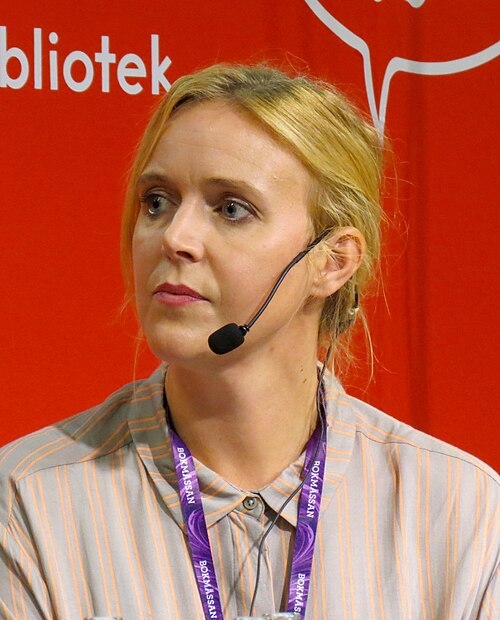
Galago publisher Sofia Olsson
Sofia Olsson has been the publisher of Galago förlag and Galago Magazine since 2018, as well as being a comic book creator of works such as Hetero in Hägersten (2010) and Det bästa barnet (2013).