
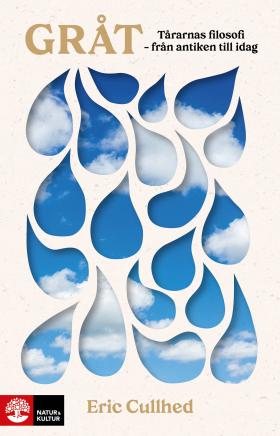
Gråt
Tårarnas filosofi – från antiken till idag
(The Philosophy of Crying: Why We Weep and What it Means)
by Eric Cullhed
Reviewed by Kate Lambert
Eric Cullhed has amassed a vast amount of material for this non-fiction book that explores the phenomenon of crying. Structuring it must have been a mammoth task. From the sub-title ‘from the ancient world to today’, the reader might expect a chronological approach starting with Greek philosophy and ending with the latest scientific research but perhaps that would have been rather dull. Instead, each of Cullhed’s chapters examines a different theory about what crying is and why we do it.
Chapter one, ‘The white blood of the soul’, a quote from Heinrich Heine, asks whether crying is a way to express suffering. Chapter two, ‘Nerve storm’, addresses whether crying is an emotional safety valve. The following chapters cover crying as consolation, as an attachment behaviour, as a reaction to goodness, a symptom of powerlessness and a call to action.
Eric Cullhed is Professor of Greek at Uppsala University and, as one might expect, there are plenty of references in the book to Greek writers and philosophers such as Aristotle, Herodotus, Euripides and Homer. But his research extends far more widely than the ancient world. The references span the globe. Examples include the understanding of the primal scream among the Igbo people of Nigeria, the people of the Andaman Islands who cry for ceremonial reasons, and examples from Indian, Chinese and Japanese literature.
Each chapter’s focus on a different theory brings together philosophers ancient and modern, scientists and the research experiments they conducted at various times in the past to the present, and popular culture – art, music, film and literature. Reactions to Rachmaninoff’s second piano concerto, James Joyce’s short story ‘The Dead’ and the film It’s a Wonderful Life all appear in chapter three. On a single page in the chapter on goodness, we encounter Swiss philosophers Deonna and Cova, Shakespeare’s Merchant of Venice, SpongeBob SquarePants and the musical Annie!. There is no risk of growing bored but one might end up slightly dizzy.
The chapters are linked by the legendary American creature, the squonk, said to live in the swamps of Pennsylvania, which weeps constantly and may dissolve into tears when cornered. The story of the squonk is provided in the introduction and the book is structured as a quest for this mythical beast. For example, the last paragraph of chapter six tells us ‘we are close to the squonk. We can hear […] its helpless sniffing echoing between the trees…’. I felt that the constant reappearance of an animal that doesn’t exist detracted from the exploration of a real human phenomenon, but I may be taking things too literally. The conceit ties the chapters together and adds a sense of progress, and readers may find it amusing to employ Thomas Aquinas, Schopenhauer and Freud, to name but three, in this hunt for an imaginary animal.
In his conclusion, Cullhed states that the ambition of the book was to open up the question of the nature of crying and to show why tears deserve a philosophical dialogue as wide-ranging as the dialogue about laughter conducted through the centuries. In this, he has definitely succeeded and the endnotes provide detailed references for readers who want to explore even further.

Gråt
Natur & Kultur 2026. 330 pp.
Foreign rights: Grand Agency, Stockholm.
In 2026 Eric Cullhed was awarded a Swedish Academy stipend by the Karin och Karl Ragnar Gierow Fund for outstanding work in the field of literary studies.