
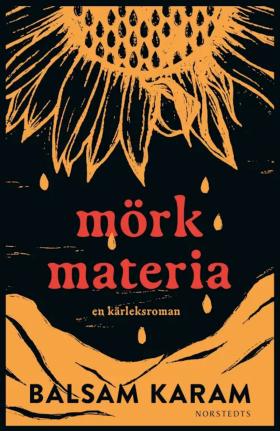
Mörk materia
(Dark Matter)
by Balsam Karam
reviewed by Margaret Dahlstrom
Balsam Karam is a Swedish writer who has published three novels. Dark Matter is the third part of the trilogy formed by these novels. For those unfamiliar with the first two parts, this volume does stand alone.
The novel is set in an unspecified country, the immediate context a small rural community outside a city. This close-knit community functions as a kind of safe haven for victims of violence and persecution in the city, and those needing to cross the border. Months before the opening point of the novel, the members of this community found and cared for a young woman who had been brutally beaten while taking action to claim unpaid wages owing to her. Apart from her obvious need for urgent care, the community members were all drawn to her on a personal level, and developed a deep affection for her as they got to know her during her recovery.
When the novel opens this young woman, Mende, has long recovered sufficiently to return to the city, telling her carers she was going to visit her family and promising to return. But they have not seen or heard from her since then. Early one morning a teenage boy in a state of hunger and exhaustion arrives at the community. Mo is Mende’s younger brother, and he is hoping to find her or at least learn where she might be.
The body of the narrative comprises conversations between Mo and various community members. These conversations take place as they go about their daily chores, and the mundane activities involved contrast sharply with their account of Mende’s experiences and her injuries. At the same time it provides some of the information Mo wants, about life in the community. The text is divided into eight sections or chapters, each named with the day of the week it relates to. There are eight chapters, eight days, but with all the memories and past events they recount to Mo, the narrative covers a much longer period: the months that Mende spent with the community, the months since she left, and aspects of Mende’s life and theirs before they knew her.
Crucial to the narrative is what is left unsaid – gaps the reader can fill to an extent, dots that can be joined, but much remains unknown. This has a strength of its own, and a role in the relationships which develop.
A strong theme of care, empathy, and affection runs through the narrative, not only in the context of the bond between Mende and the others, but also the connections between the community members, and the deep affection between Mende and Mo.
The title, Dark Matter, references a concept in physics, the details of which are beyond the scope of this review and way beyond this reviewer. But since Karam has said her own knowledge of dark matter is minimal, the reader needs only a general description. Dark matter is an invisible substance in space which is perceived through its gravitational effects on visible objects. For our purposes, the most pertinent description is by NASA: ’Dark matter is the invisible glue that holds the universe together’ (https://science.nasa.gov/dark-matter/).
Karam’s work has the subtitle ’a love story’; and the love in this story is a broad, bonding type rather than a romantic variety. This emotional force, then, is the invisible glue that keeps people together, in the present context even in the face of violence, danger and destruction.
Significantly, dark matter is an unproven hypothesis. But here the parallel ends – Karam’s characters leave no doubt about the power of their emotional bond, and even the fact that the novel is a fiction does not seem to undermine this.

Mörk materia
Norstedts, 2025, 228 pages
Foreign rights: Norstedts Agency
Balsam Karam is an author and librarian and made her literary debut in 2018 with the critically acclaimed Händelsehorisonten (Event Horizon), which was reviewed in SBR 2018:2. A translated extract appeared in SBR 2020:1. Her second novel, Singulariteten (The Singularity) was reviewed in SBR 2021:2.