
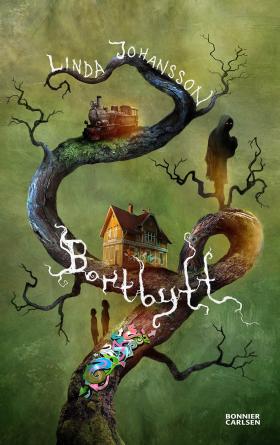
Bortbytt
(The Changeling)
By Linda Johansson
Reviewed by Amanda Landegren
The plot of Bortbytt centres around a railway restoration project – a railway that has twice over resulted in the disappearance of a child. Hella, the protagonist, mobilises the power of her friends to convince the municipality and the people of Rönnås that history cannot be allowed to repeat itself.
In this novel aimed at readers aged around 9-12 years, Johansson returns to the setting of the Swedish small town, which she has previously explored in her young adult urban fantasy Bloksbergstrilogin (the Bloksberg trilogy).
As in her previous work, Johansson draws on local legend and folklore to examine the local stories attached to a place's past, tracing how some remain in the collective memory while others fade or are suppressed over time. In the Bloksberg trilogy, the action quickly moves to a fantastical secondary world, but here we stay firmly in Rönnås and get to unravel local history together with Hella. Like a detective, she has to piece together forgotten and sometimes conflicting accounts of what actually happened during the town’s disastrous prior attempt to open the railway.
The antagonists of the story are not only the unknown creatures of the forest, but also the municipality and local politicians who are ready to forgo warnings and harm the forest in order to further their own ambitions. Johansson thereby skilfully juxtaposes the harm inflicted by the fantastical forest monsters and the mundane, ignorant bureaucrats.
In terms of genre, Changeling moves comfortably in the realm of urban fantasy, but follows contemporary trends of mixing in a fair amount of ecological horror. As the 2026 Book Tasting, a yearly analysis of publishing trends made by the Swedish Children’s Book Institute, shows, several authors have turned towards depicting the forest as a threatening, contested and uneasy space. Eco-horror is normally not a label given to children’s books, but Johansson’s novel displays several of the themes associated with the genre: the claustrophobic, cyclical temporality, and the subversion of nature as an idyllic place for recreation and development. However, while Johansson draws confidently on familiar tropes from both urban fantasy and eco-horror, the novel is likely to appeal most to readers who enjoy these established conventions rather than those looking for unexpected twists on the genre. We have a somewhat marginalised, artistic character seeking refuge in nature and creative expression, a small town depicted as an unthinking entity in the face of the supernatural, and a heroic young protagonist who is able to realise what is actually happening. It is well done, certainly, but not overly surprising.
As is common in urban fantasy, Changeling ultimately turns its gaze towards contemporary society. One of the novel’s strengths is that its social critique is unusually concrete. Rather than simply invoking vague anxieties about ’modern society,’ Johansson explicitly points to underfunded healthcare, closed kindergartens and municipal decision-making that directly shape the everyday lives of people in Rönnås. Initially, responsibility for the town’s problems is presented as structural: the novel shows how political priorities create the conditions that allow both ecological destruction and human suffering. This makes it somewhat disappointing that this perspective narrows as the story approaches its climax, mainly becoming concentrated in the figure of the head of the municipality, whose willingness to ignore repeated warnings makes him an effective antagonist but also absorbs a broader critique that had previously also targeted institutions and systems. Once tragedy inevitably strikes, questions of accountability largely disappear from the narrative. In the final pages of the book, supernatural conflict takes centre stage, whilst political responsibility fades into the background.
That unresolved tension encapsulates my experience of Changeling as a whole. Johansson is an assured storyteller with a strong grasp of atmosphere, and the novel succeeds in making the Swedish forest feel genuinely unsettling. It sits firmly and competently within established genre conventions. Yet its most interesting ideas – about memory, local history and political responsibility – are left somewhat unresolved. There is a great deal of potential to be further developed in a sequel.

Bortbytt
Bonnier Carlsen, 2026. 239 pp.
Foreign rights: Bonnier Publishing
Linda Johansson is the author of several novels for younger readers, often with supernatural elements.