
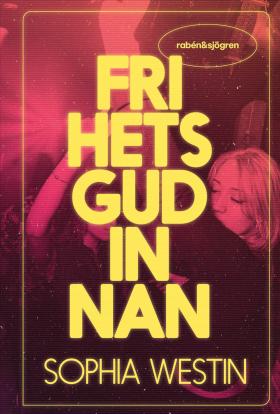
Frihetsgudinnan
(Lady Liberty)
by Sophia Westin
reviewed by Sophie Ruthven
Nineteen-year old Vendela has come to a conclusion: she can’t go on like this any longer; she has to tell the person she’s in love with how she feels. The problem is, that person is her best friend, Blanca. Vendela and Blanca have been inseparable since their early childhood. They know everything about each other and do everything together, but Vendela knows she wants more than that. So one day, as the two of them are hanging out ahead of a concert by their favourite artist, Vendela plucks up the courage to say what’s on her mind and she’s been wanting to tell Blanca for a while. Blanca responds that she has also been meaning to tell Vendela something...
Vendela’s heart skips a beat: could this be it, could their feelings be mutual? Then, Blanca asks her whether Vendela has met someone, just as she has? And so, at her most vulnerable moment, Vendela finds out that Blanca has met Luna. Not only that, but they’ve started dating. Blanca is dating another girl. Not Vendela. Nonetheless, Vendela says that it’s fantastic news.
It’s all too much, but the spotlight is soon back on Vendela as Blanca apologises for butting in and says she can’t wait to hear her best friend’s news. All of a sudden, telling the truth no longer feels like an option. So she tells Blanca the next best thing: a lie that she’s met someone too. A New Yorker, who she’s just spent an incredible weekend with, who is now back in New York and who can’t wait to see Vendela again. Blanca is over the moon with excitement. Imagine seeing New York! All the famous sights, the places from Friends! She asks Vendela if she’s thinking of going there. This is getting out of hand, but Vendela can’t stop. And in her panicky wish to be as far away from Blanca and her new girlfriend as possible, she says of course: on Monday. That’s the big news!
After an excruciating experience at the gig, where Blanca and her girlfriend get close to each other while all of Vendela and Blanca’s favourite songs are performed, Vendela considers it might be best to follow through. So instead of coming clean, she books a flight the next day. And the day after that, she’s on a plane to Newark, where she meets the free-wheeling Carmen, who shows her the sights and new ways of thinking. Little does she realise the effects of her dishonesty, her desire to take charge as Vendela 2.0 and her concept of freedom impact on all her relationships.
Vendela’s lack of self-esteem is one of the main drivers of the many problems she runs up against. Her ruminations, initially endearing, lead her to become so self-centred that she can’t see the woods for the trees, only able to comprehend her own emotions and consequently burning the people around her. It leads her to do something abysmal to Blanca, though, at the time and with the information she has, she believes wholeheartedly it’s the right thing to do. Lady Liberty is a great story to illustrate that ‘doing what you thought was right’ isn’t always enough when it comes to some actions we take, especially when we’re making calculations with the wrong information or from a problematic perspective.
Carmen, the local who takes Vendela under her wing, certainly behaves in her own problematic ways, but can Vendela truly blame everything she gets wrong on being led astray by her new friend? Is she instead refusing to recognise her own cowardice, her concept of individualism a form of irresponsibility? ‘I realise that an apology doesn’t need to be another monologue about my feelings’ she notes at one point in a moment of self-awareness. One of the most poignant sequences comes from her reuniting with her high school exchange partner, Duncan, now a student in the city. As someone with his own reasons to be curious about the welfare state, Duncan’s outsider-looking-in observations of Swedish society might seem idealistic, but they are grounded in a deeply compassionate personality. His willingness to give Vendela a second chance if she faces her issues, and what she blindly does with that, creates a real heartbreaking depth to the story.
The novel is clearly structured in a familiar manner without being predictable, and the themes are clear enough from the get-go: friends and Friends, capitalism and socialism, individual freedom and its openness to misunderstanding and misuse. With a pacy humorousness that gives way to urgent existentialism, Lady Liberty is a delight, if a sobering one.

Frihetsgudinnan
Rabén & Sjögren, 2025
253 pages
Foreign rights: Rabén & Sjögren Agency.
This novel, Westin’s debut, won the 2025 Slangbellan prize, a Swedish literary award given annually to the best debut book in children's and young adult literature.