
Årets by
(Village of the Year)
by Hilda Westerberg
Reviewed by Darcy Hurford
Moving house feels unsettling enough for many people. How it would feel to have your whole town moving must be even worse. For the inhabitants of Kiruna in northern Sweden this has been the case since the relocation was decided on in 2010, and the situation continues to this day. Due to underground subsistence from the local ore mine, the city is being moved three kilometres east, building by building, in a process billed by the Guardian as ‘the world's most radical relocation project’.
For the characters in Hilda Westerberg’s short story collection Village of the Year the relocation is a collective experience that is profoundly unsettling. The story begins when Hilda moves back from Stockholm to her mother’s home region and reconnects with old acquaintances and makes new ones in a series of short stories spanning the years from 2018 (Tornedal Rally), to ‘The Last Festival in 2022. (A recurring question in the book is why she moved up north. Her answer never seems to satisfy the enquirer.)
Hilda finds herself in a place where buildings are being moved all the time. One of them is the town hall, described in ‘The Old Town Hall, 2018’, where we learn that when the first few houses were relocated, ‘people followed the rolling buildings like a funeral procession’ with the sardonic observation that ‘The media were there, but perhaps not their most prominent reporters’. One character notes her parents got married in the old town hall, and final line is: ‘Regardless of whether or not you had any feelings about the buildings, something had changed. It was as if the absence of the landmark changed the gravitation of the whole town… It made me dizzy.’
The title itself has an ironic undertone. While ‘the village’ is a recurring theme in this collection, it does not always have happy associations even if it is a central part of the characters’ identity. What is meant by ‘the village’ varies according to whom you ask, but for the narrator’s friend, and for the narrator’s mother, it is Lainio, close to the border with Finland. The village of Vittangi, which appears here frequently, has problems with drug abuse, yet was Village of the Year in 2007.
While the dialogue itself is quite minimal, it contains plenty of social criticism, albeit in understated form. The labour market is a recurring theme: we meet people who fly up from Stockholm every other week to work in the mine as it’s apparently better paid than anything in Stockholm. Someone else gets a job in the ore mines and follows the usual path: ‘work one week, do drugs the next’. Linda explains that her parents originally moved up here to work at a labour exchange helping locals to find jobs down south in the 1980s. Neither stayed.
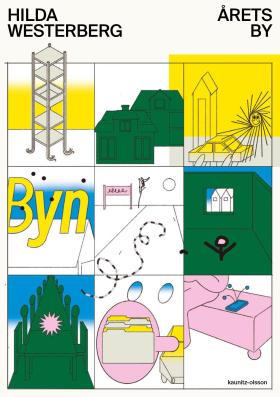
Construction and reconstruction are an ongoing theme here. Maybe this is why the illustrations so often resemble something from a set of IKEA assembly instructions, or a Fisher Price assembly toy, with a colour palette dominated by yellow, pink, dark green and blue. The drawings are simplified, symbolic figures rather than detailed realistic depictions of people and the environment, more like diagrams and maps than landscapes. One character has the head of an apple, for example. Another memorable image shows the characters’ heads on a tray, on table, talking about a music festival in Karesuando. Elsewhere there is a parody of Pippi Longstocking holding a horse above her head. It’s an abstract style of illustration that shows characters and situations as processes, and emotions are shown through movement: to illustrate the above passage on dizziness, the head of the character is shown in profile sixteen times in a row in varying sizes, with a grey loop connecting each head and anonymous figures marching underneath. Maybe it’s too abstract; maybe the illustration style makes a point about the dehumanising effects of industry. These are bizarre-looking characters for bizarre-sounding but interesting stories.

Årets by
Kaunitz-Olsson, 2026. 223 pp. ISBN: 9789189924451.
Foreign rights: contact publisher.
Hilda Westerberg is an illustrator and cartoonist who lives in Malmö but has her roots in Kiruna and Torneådalen. Årets by is her debut.