
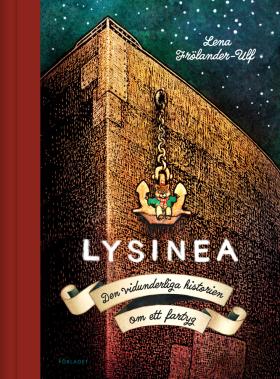
Lysinea - den vidunderliga historien om ett fartyg
(Lysinea – the Marvellous Story of a Vessel )
By Lena Frölander-Ulf
reviewed by Darcy Hurford
Does a dystopia have any business looking this good? Over the years the Finland-Swedish children’s writer and illustrator, Lena Frölander-Ulf has developed a signature illustration style based on a scraping technique that, in extremely simplified terms, means first scraping figures into a foundation layer, followed by a layer of colour, followed by merging the layers together. The end result is striking: a lot of black, but with colours that really pop out from the background. You can almost feel the textures. It is atmospheric, and works well for the steam-punk-esque setting of Lysinea. The book opens with diagrams of the ocean liner that gives the story its name.
In the small hours, at ten past four to be precise, Rusty the fox wakes up because it’s so cold in his cabin in the second-class area. Sensing something is wrong, he goes off to investigate. It turns out that the ship, filled with animals escaping a disaster and searching for land, has stopped in the middle of the ocean, and is gradually sinking. He sees guards entering the third-class deck, and eventually makes his way there too, despite entry into other passenger classes being strictly forbidden. There in third class he makes new friends – Isa, Tatlo and Dalawa - and together they try to hatch a plan to save the ship. Exactly what kind of animal his three new friends are is not stated, but the fact their father is called Komodo might be a clue.
However, they meet stubborn resistance from the higher classes, particularly Captain Pelican, who insists nothing is wrong, and by characters in second-class such as Rusty’s erstwhile teacher, Ms Mauser. The only adult who seems to want to help is Bones, a fatalistic dog who mainly sits in his cabin carving potatoes but is a mentor figure to Rusty.
Rusty himself is something of an enigma. His background is lightly sketched in the early pages of the book. His parents drowned in the disaster that preceded the ship’s departure, and since then he has always lived on the liner, looked after by Ms Mauser and Bones. This sense of enigma is echoed in the illustrations: we rarely see Rusty face-on, but often as a reflection in a mirror, or behind a vase, or through a window in a door, or as in one particularly ingenious image, reflected in a row of metal trays on a kitchen counter. The reader doesn’t really see Rusty himself so much as the world through Rusty’s eyes.
The events leading up to the Lysinea’s original departure are also rather hazy. Why exactly did it leave? What decided who was allowed to board it? How long has it been sailing in search of land? and so on. However, the story works much better without all those details. We can tell there must have been some kind of natural disaster. If the author had decided to include a fully-sketched backstory, the book would have run the risk of being derailed into a presentation of the evils of climate change, which would not only have detracted from the adventure of the stranded ship, but also turned it into a lesson. Which is not to downplay the importance of climate change, but to note that there is a time and place for describing it in detail. Lysinea has the result of awaking curiosity, of making readers think about the issue for themselves, which an overly didactic approach might not have achieved. The same applies to the social hierarchies depicted in the book. Onboard the liner, first, second and third classes are separate, with the latter referred to as ‘thick-skinned’ by Ms Mauser and treated as undesirable by many of the other characters. A reader sees clearly how wrong this is, without having it spelt out, and this too offers food for thought even after reading.
This is a book that can be enjoyed on many levels. There are echoes here of the Titanic, particularly as shown on film, because of the class hierarchy and impending sense of doom as well as the old-fashioned world depicted (even if the security guards have walkie-talkies). Another Swedish literary reference is Aniara, Harry Martinson’s science fiction epic of a doomed spaceship carrying a cargo of colonists that is thrown off course. Luckily Rusty and his friends ensure that things end much more happily for the Lysinea.

Lysinea – den vidunderliga historien om ett fartyg
Förlaget M (Finland). 232 pp. ISBN: 9789523337299.
Foreign rights: Rights & Brands.
Lena Frölander-Ulf is the award-winning author and illustrator of numerous books for children, notably the Rafsa trilogy centring on Rafsa the marmot, and Me, Fidel and the Forest (‘Jag, Fidel, och skogen’) which was reviewed by Charlotte Berry in SBR 2017:1.