
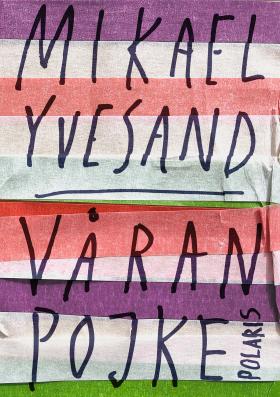
Våran pojke
(Our Lad)
by Mikael Yvesand
reviewed by Sophie Ruthven
Just as in his bestselling and prize-winning debut novel Häng City (Hang City), it’s boys from the Swedish periphery who are central to the narrative in Yvesand’s Våran pojke (Our Lad), a title with more than one meaning. Framed by two bombastic descriptions of a planet-wide yet descriptively localised apocalypse, Våran pojke follows Johan’s first-person narration of his very ordinary childhood with the friends he falls in with, through to his early twenties. Well, ordinary enough, except for a rupture in his teens when he commits a brutal crime. Escaping notice, the perpetrator manages to live an ordinary life, albeit one low on self-management and motivation. It’s apparent that a lot of life does not come easy to him, and his childlike view of the world – so well portrayed in Häng City – carries over into Johan’s early twenties. Although his numbers go up, he doesn’t seem to get any older on the inside. And is there a reason why he has no interests nor skills? Perhaps not. He is just uninterested and, as a painful encounter with an old school friend towards the end of the novel reveals, probably just uninteresting. Life allows him to exist safely, but nothing more: and he doesn’t want any more.
The contrast of his mundane continuation of life with the extraordinary action taken in his past is the catalyst for the bizarre atmosphere, and this is amplified by his neighbour Jonna accepting a squatter in the form of a peculiar undercover agent called Glenn Bensino, and her partner beginning to age backwards. And through all this, the 90s music references and torrent downloading the peculiar, lonely figure of Johan can be glimpsed.
The change in mental distance I felt towards Johan before and after his moment of violence created a book of two halves. From feeling close to him as a reader through his late childhood, the distance such a violent crime puts between reader and a main character is huge. Like Glenn Bensino, who enters the narrative in this second half as ordinariness starts to fray, it felt much as if I switched automatically to observation mode, no longer seeing Johan as a regular human, even though in all other descriptions and trappings, he was still exactly that: albeit one without empathy or interests. Despite this shift from closeness to distant observation, however, the novel never felt as if it was trying to answer a question of ‘why do seemingly ordinary, slightly lonely young men do such things?’ Whether or not Johan feels guilt is not a central question here, and yet Våran pojke pulls itself inexorably forward and the reader with it, ratcheting up the discomfort as the undercover agent settles into his neighbour’s house and indicates that there have been mysterious, top-level activities taking place around this area. But whether or not any of it links to Johan and his crime is hard to tell.
Like the previous novel, Våran pojke also moves into multiple strands, one part of which contains an element of crime investigation, though not of the crime you would expect. There are the dated ‘diary entries’, which occasionally indicate an awareness of being reported to an authority. The omnipresence of authorities and the narrator’s relationship to them and their opaque ways is somewhat familiar from Häng City, and, once again, there is a brutal crime in an otherwise unchanging suburb. But this time the surreal is ratcheted up a notch and then another notch as the narrative of Johan’s neighbour, Jonna, becomes a strange dance in time.
The second storyline of Jonna (or is it Johan’s childhood budgerigar in human form?) never truly connects up to Johan, which some may find irritating. It’s quite Yvesand though. The sense that everything has been written for the fun of it and on its own terms, and a story has come out of it. Whilst Jonna’s voice at times peculiarly seemed too similar to Johan’s voice, that has its own effect on the atmosphere.
As in Häng City, much of the novel just simply is. Yvesand has the ability to draw you in to follow the mundanities of daily life, and as adult Johan trains as a cleaner it becomes relaxing to follow him mopping and hoovering. Whilst there is slightly less overt 90s childhood nostalgia here, the small-town world is as rich and fully-fleshed as before, in all its urbane trimmings.
Våran pojke is probably not a book for people who want to ‘understand everything’, more for people who find Murakami a way to relax. It is very funny at times. And also, very creepy. Part of my mind kept wondering whether we’re supposed to be psychoanalysing Johan. But then again, I don’t think we’re ‘supposed’ to do anything with this text.

Våran pojke
Polaris, 2025, 352 pages
Foreign rights: Politiken Literary Agency
Nominated for the August Prize 2025
Mikael Yvesand’s debut novel, Häng City (Hang City) was reviewed in SBR 2023:2. An excerpt from the novel was featured in SBR 2024:1.