
from The Marionettes. A Tale of the World as Political Theatre
(Marionetterna. En berättelse om världen som politisk teater)
by Ingrid Carlberg
Translated by Ian Giles
"Relentless darkness has descended upon Sweden and Stockholm. I am fed up of the hate – fed up of all the lies and exaggeration stealing the oxygen. I cannot deal with yet more internet trolls and peculiar rebellions. There is but one question that I wish to answer before we asphyxiate: how did we end up here? The people who have found their way into my narrative are not even villains. The truth is that most of them did not realise what was actually happening. They cannot deny their role in the game, but they were driven primarily by a strong personal conviction about what was best for the world (not to mention their own pockets). What about the puppeteer? I would guess most people did not even see the strings. Or perhaps they preferred to look the other way if they did. Highly intricate propaganda strategies are predicated on the principle that any trace of strategy must be erased.”
(Ingrid Carlberg)

Washington, 6 January 2021
‘The only certainty we had was that some Nazi circles had somehow contrived to burn down the building.’ (Arthur Koestler)
The week before the storming of the Capitol in January 2021, apprehension was already spreading throughout the American capital. The indications that unrest was expected had been so manifold – especially following the tallying of the electoral college votes confirming that the sitting president Donald Trump had lost the election.
For months, Trump and his team had been cranking up the electoral fraud rhetoric. Following election day on 3 November 2020, the ensuing diatribes were peppered with lies about ‘the stolen’ presidential election, about millions of missing votes for Trump, manipulated voting machines and fake voters. States in which the result was close were bombarded by appeals from the Trump camp – to no avail. Even following recounts, the facts showed the opposite: the election had been free and fair. Now all that remained was the ceremonial joint session of Congress to count the electoral college votes which would officially name Joe Biden as the president-elect of the USA.
The mood among Trump’s supporters and his coterie of right-wing extremists and conspiracy theorists was at fever pitch. Among these was the militant organisation the Proud Boys, whose acts of violence Donald Trump had refused to condemn during the election campaign. The president’s reply had, in fact, sounded rather more like encouragement: ‘Proud Boys, stand back, stand by!’. On social media, the Proud Boys leader Enrique Tarrio replied: ‘Standing by, sir’.
After the setback in the tallying of electoral college votes, the Trump campaign set its sights on the joint session of Congress on 6 January. ‘Statistically impossible to have lost the 2020 Election. Big protest in D.C. on January 6th. Be there, will be wild!’ Donald Trump tweeted on 19 December. Trump supporters spread the message too: ‘TRUMP TWEET. DADDY SAYS BE IN DC ON JAN. 6TH’. In some forums, discussions were focused on how to move weapons into the District of Columbia. In their view, they were doing as they were told. As one of their number put it, ‘we’ve got marching orders, bois’.
When indications of a mobilisation were combined with continued Trump outbursts about the stolen election, the Joint Chiefs of Staff Chairman Mark Milley felt his sense of unease rising. In the presence of his colleagues, he commented on the similarities between Trump’s use of language and the dystopian novel 1984 by George Orwell. ‘Lies are truth. Division is unity. Evil is good’, the general noted.
‘JANUARY SIXTH, SEE YOU IN DC!’ the President once again tweeted the day before New Year’s Eve. The response from the pro-Trump channels: ‘The cavalry is coming’. Milley, a history buff, was unable to shake the impression that the terrifying events of the early 1930s in Germany appeared to be repeating themselves.
‘This is a Reichstag moment,’ Milley told aides. ‘The gospel of the Führer.’
In the final weeks of December 2020, the core of Trump’s campaign moved into a ‘war room’ at the Willard Hotel not far from the White House. It was from here that the president’s adviser Rudy Giuliani, the former mayor of New York, was now heading up the campaign to stop the handover of power. Also present was Trump’s lawyer John Eastman. They were often joined by former White House chief strategist Steve Bannon, who had made peace with Trump and had been lurking in the background throughout the election campaign.
Their strategy was now based on forcing vice president Mike Pence to violate the constitution. In the USA, the vice president is the presiding officer in the Senate, and is formally tasked by the constitution with presiding over the receiving and counting of electoral ballots cast in presidential elections. Pence ought to be able to reject some of them, so the thinking ran in the war room at the Willard.
On the evening of Tuesday 5 January, Donald Trump met with his vice president in the Oval Office. Outside, the din from Trump supporters was palpable – they had already begun to mass at Freedom Plaza with their ‘Make America Great Again’ flags and banners. In their book Peril about the final days of the Trump presidency, Bob Woodward and Robert Costa describe the meeting. According to interviews with eyewitnesses, Trump pressed Mike Pence one last time.
‘You can do this. I don’t want to be your friend anymore if you don’t do this,’ the president said.
Mike Pence then tried to explain that his role was merely to open the envelopes.
‘You’re not going to be sworn in on the 20th. There is not a scenario in which you can be sworn in on the 20th’, Pence said.
A furious Trump raised his voice. He accused his vice president of being weak and lacking in courage. ‘You’ve betrayed us. I made you. You were nothing. Your career is over if you do this.’
The vice president’s face was reportedly ashen as he left the Oval Office.
Close by in their suite at the Willard, Rudy Giuliani and Steve Bannon were waiting. Trump called them and told them about Mike Pence’s ‘arrogant’ refusal. Their strategy had failed.
In the podcasts dropped by Bannon that day, the USA is portrayed as a country in a state of constitutional crisis. ‘[T]hat crisis is about to go up about five orders of magnitude tomorrow’, he said, adding that the crisis wasn’t ‘going to happen like you think it’s going to happen. OK, it’s going to be quite extraordinarily different. […] You made this happen and tomorrow it’s game day. So strap in. Let’s get ready. All hell is going to break loose tomorrow. [...] So many people said, “Man, if I was in a revolution, I would be in Washington”. Well, this is your time in history.’
The marching orders came shortly after 1pm on Wednesday 6 January. President Donald Trump gave a speech to ten thousand supporters on the Ellipse (a park close to the White House) surrounded by fluttering stars and stripes and banners emblazoned with the words ‘Save America March’.
‘Because you’ll never take back our country with weakness. You have to show strength and you have to be strong. We have come to demand that Congress do the right thing and only count the electors who have been lawfully slated, lawfully slated. I know that everyone here will soon be marching over to the Capitol building to peacefully and patriotically make your voices heard’, the President said. ‘We fight like hell. And if you don’t fight like hell, you’re not going to have a country anymore. [...] So we’re going to, we’re going to walk down Pennsylvania Avenue. I love Pennsylvania Avenue. And we’re going to the Capitol.’
When the protestors arrived, the Proud Boys’ hooligans were already at Congress. An hour later, the storming of the Capitol became fact. Windows were smashed, doors forced and an angry crowd of several hundred Trump supporters flooded into the building, many of them wrapped in the American flag. Donald Trump followed the unfolding drama on a big screen television in the dining room adjacent to the Oval Office. Photographers were assaulted, police officers kicked to the floor and congressmen and women fled for their lives. The angry mob were shouting ‘Hang Mike Pence!’. As the vice president and his family were rushed to safety just metres away from the rioters, Trump took to Twitter: ‘Mike Pence didn’t have the courage to do what should have been done. […] USA demands the truth!’.
Shortly thereafter, the Republican Minority Leader of the House of Representatives managed to get hold of Trump on the phone. Terrified, he pleaded with the president to intervene, but was told by Trump that the rioters were not his people. The White House ‘truth’ was that the mob consisted of anti-fascist left-wing activists who had infiltrated Trump’s peaceful demonstration.
Only at around half past four following repeated attempts at persuasion from near and far did President Trump reluctantly post a video. By then, a number of people had died and far more had been injured.
‘I know your pain. […] We had an election that was stolen from us. It was a landslide election and everyone knows it, especially the other side. But you have to go home now. […] We have to have law and order. […] This was a fraudulent election. But we can’t play into the hands of these people. We have to have peace. So go home, we love you. You’re very special.’
The president’s adviser, Steve Bannon, had made no attempt to conceal his totalitarian sources of inspiration. At the beginning of Trump’s term in office, he had drawn attention when he described himself as a Leninist and explained how just like Lenin he wanted ‘to bring everything crashing down and destroy all of today’s establishment’.
Lenin’s toolbox for global revolution included the strategy of using parliamentarianism to undermine parliamentarianism, unscrupulously exploiting the democratic machine to overthrow it. Communists in the west were urged to act like bulls in China shops, doing all they could to discredit their parliaments. Not that they were always comfortable doing so. Didn’t the Bolsheviks understand this kind of behaviour would only lead to the communists being discredited?
In the USA, plenty remembered Steve Bannon’s passion for the ‘deconstruction of the administrative state’. On the most recent occasion, it had been in relation to his failed venture into the formation of a right-wing nationalist movement on an international level, fittingly known as ‘The Movement’, ahead of the European parliamentary elections in May 2019. ‘The beating heart of the globalist project is in Brussels’, Bannon told The Guardian during The Movement’s grand opening phase. ‘If I drive the stake through the vampire, the whole thing will start to dissipate.’
Less widely known was that Steve Bannon had simultaneously spread The Movement far beyond Europe’s borders. In the beginning of 2019, it was announced that the son of the Brazilian president Jair Bolsonaro, congressman Eduardo Bolsonaro, had been appointed the official representative of The Movement in South America. ‘I’m very proud to join Steve Bannon as the leader of The Movement in Brazil […]. We will work with him to reclaim sovereignty from progressive globalist elitist forces’, said Eduardo Bolsonaro.
Anyone following Eduardo Bolsonaro’s tweets already knew he had been in close contact with Steve Bannon, with a selfie here and a selfie there providing ample evidence. One day, they vowed to work together to combat cultural Marxism, while on another he was invited to Bannon’s birthday dinner. Jair Bolsonaro claimed to be unaware of his son’s contacts when confronted with questions about the partnership. Eduardo merely shrugged and offered the reassurance that there was no money involved, it was only ‘internet tips, sometimes an analysis, interpreting data, those kinds of things’.
In late February 2020, Eduardo Bolsonaro tweeted from a dinner in Washington. In the picture he was sitting at a decked out table between Steve Bannon and the British Eurosceptic-in-chief Nigel Farage. They were listening to a speech from Fox News anchor and guiding light Laura Ingraham. ‘Also present were conservatives/nationalists from Spain, Sweden, Finland, Estonia, Belgium, Germany, Czech Republic, Mexico and France’, Bolsonaro tweeted.
Two years later in October 2022, his father Jair Bolsonaro went on to lose the Brazilian presidential election to Lula da Silva. Bolsonaro never admitted defeat, instead leaving the country and travelling to Florida where he, among other things, marked the New Year with Donald Trump at Mar-a-Lago.
In Brazil, a wave of protests and mass gatherings erupted in response to supposed electoral fraud. Among the many viral lies was Steve Bannon’s line which he had diligently rehearsed: ‘Lula stole the Election...Brazilians know this.’
On Sunday 8 January 2023, the world was shocked by an attempted coup against the Brazilian Congress in the capital city of Brasilia. Thousands of Bolsonaro followers had been bussed into the city. Dressed in the green and gold of the Brazilian flag, they overturned anti-riot fences and stormed the congress building, smashing windows and vandalising the interiors. They also entered the presidential residence and the Supreme Court. ‘Brazilian Freedom Fighters’, Steve Bannon tweeted.
Brazilian security forces were forced to use tear gas to regain control over the institutions of Brazilian democracy.
The basic foundation of democracy is respect for the rules of engagement in democracy. Therein lies democracy’s greatest vulnerability. Willi Münzenberg’s colleague Arthur Koestler, who was fervent participant in the disinformation wars following the 1933 Reichstag fire, would later in life come to reflect extensively on this. He recalled the beneficial insights he took from the racket of totalitarian propaganda that characterised the struggle between the giants Goebbels and Münzenberg. As he writes in his memoirs:
"It had taught me that in the field of propaganda the half-truth was a weapon superior to the truth, and that to be on the defensive is to be defeated. It taught me above all that in this field a democracy must always be at a disadvantage against a totalitarian opponent. My years with Muenzenberg have made me sceptical regarding the West’s chances of waging “psychological warfare” against opponents like Hitler and Stalin. For to wage effective psychological war the West would have to abandon precisely those principles and values in the name of which it fights."
[...]
Portland, Amsterdam, Stockholm and Washington, 2017–2021
‘Make the world gasp with horror’ (Willi Munzenberg)
The still is dark, but no one can mistake the message. A masked, black-clad man is kneeling before a fire. Next to him is a white, handwritten sign which reads ‘Black Lives Matter’. In the fire, an American bible is visible. The flames have just begun to lick the edges, but the cover remains fully legible: The Holy Bible.
The image is taken from a video that quickly went viral during the 2020 American presidential election campaign. It was filmed at a protest held by the Black Lives Matter movement in the city of Portland in late July. ‘This is who they are’, the Republican senator Ted Cruz spewed on Twitter as he shared the image on 1 August. Donald Trump Jr thundered that the anti-fascist left-wingers had reached the ‘book burning phase’.
A week or so later, the New York Times revealed that the video of the bible burning had been created by the Russian English-language television channel RT (Russia Today) and its video production company Ruptly. ‘Ruptly and RT then let Twitter take it from there’, the newspaper wrote. The film bounced onto social media via a peripheral Twitter handle (later deleted), and from there it rose to prominence through viral sharing in American right-wing nationalist circles. A minor Twitterstorm ensued during which the number of bibles apparently being burned quickly mounted and then the burning became the main point of that evening’s demonstration. In fact, other protesters barely seemed to register what was going on. The two figures clad in black responsible for igniting the fire had by all appearances only burned one single bible – or perhaps one more to provide Ruptly with extra footage.
According to the New York Times, the planted bible burning was an example of new Russian methods of disinformation where the troll factories and fake accounts on social media from 2016 had been replaced by so-called ‘information laundering’. It was an inventive name. Just like illicit cash, planted false stories could be laundered of their Russian origins by primarily being spread via existing domestic sites and accounts. The desired effect – rage and inflamed conflict – was the same, but it was harder to trace the source without trampling across citizens’ democratic right to react and express themselves freely.
The New York Times noted that American intelligence sources had warned of covert attempts to elevate American racial antagonism ahead of the presidential election. The newspaper also highlighted that disinformation was about more than downright lies, but also half-truths, and that falsehoods have the greatest effect when they are based on a small kernel of truth.
This ‘information laundering’ was hardly a new phenomenon. In books on covert political influence operations, the strategy is described as establishing a stand-alone ‘echo chamber’. Like-minded people repeat the planted news or claim and reinforce it by echoing it. In echo chambers, the fever pitch is elevated and language degrades.
The trolls in Saint Petersburg and the automated fake accounts on social media also served this function in 2016 – ‘the online equivalent of the laugh track in a studio-taped TV show’ as Thomas Rid puts it. The method was also found in the Soviet arsenal in the 1970s and 1980s. ‘Even the most blatant lies [that the Soviets disseminated] took on a life of their own’, Anton Shekhovtsov notes in his book Russia and the Western Far Right: Tango Noir. At the time, Soviet intelligence officers were given special training in how to use disinformation as a weapon. They were to track frictions, discontent and antagonism, identifying the greatest vulnerabilities and ensuring they were exploited.
When the Russia Today television channel was launched in 2005, Vladimir Putin declared it was aimed at breaking ‘the Anglo-Saxon monopoly on the global information streams’. Following the 2008 war in Georgia, those ambitions were amped up. The Kremlin felt it had been defeated in the West in the war of opinion around the invasion, and Putin began to gear up for information-based warfare in response. Russia Today was rebranded as RT (to avoid a less obvious connection to Moscow) and the content in its foreign programming shifted from positive news about Russia to blackening the reputation of the West. The idea was for RT to operate more or less like an international news agency – or propaganda agency.
In this respect, they faced a strategic challenge. If the goal was an international media breakthrough then the desired echo chamber could not be confined to Russian voices. The like-minded individuals who would comment and amplify anti-Western propaganda needed to hail from western nations. Moscow knew where its sympathisers were to be found. Many of Europe’s leading right-wing nationalists – Austria’s Heinz-Christian Strache, France’s Marine Le Pen and with the passing of time even Italy’s Matteo Salvini – began to contribute to RT broadcasts as ‘experts’. Kent Ekeroth from the Swedish far-right populist party the Sweden Democrats was another commentator who frequently appeared on air with RT.
The right-wing nationalists had nothing against besmirching either the EU or the core values of liberal western democracies while live on RT. Lies and hateful language posed no obstacles to them. After all, their political goals aligned with those of Putin’s Russia, and they were more than happy to make their voices heard.
The European alternative-right also offered its own media outlets. Online, so-called alternative media operations with right-wing and nationalist overtones began to mushroom at around this time. They were portrayed as the rebellious contenders to the ‘legacy media’ of the media ecosystem.
I carry out a randomised spot check, selecting eight European countries and forty known alternative media outlets established across them between 2007 and 2017. When I review their domain registration history, I see that the peak appears to have been around 2008–2009 when Moscow was ramping up its information war. In that period, sixteen of these forty right-wing nationalist alternative media outlets registered their domains in the space of twelve months. Seven of them saw the light of day in the space of just a few weeks over the course of November and December 2008. Registrations were otherwise fairly evenly spread across the decade in question, with a few trickling through each year.
This cluster of upstarts around the 2008–2009 period may be coincidence – online newspapers were the zeitgeist. Nonetheless, the result was a startlingly rapid and forceful strengthening of the media-based echo chamber that the Kremlin believed best served the interests of Russia.
Sweden Democrats politician Kent Ekeroth launched the blog and news site Politiskt inkorrekt [Politically Incorrect] in late October 2008. He was joined on the editorial team by Chang Frick, a locally elected Sweden Democrat politician from the county of Skåne in southern Sweden. The site was framed as an ‘antithesis to the skewed, adulterated and mendacious articles being pumped out by the established media’. The tone was crude, the content strongly anti-immigrant and xenophobic. Before long, the blog had more than a million hits and was one of the biggest in the country. Following the 2010 Swedish general election, Politiskt inkorrekt claimed some of the credit for the Sweden Democrats’ entry into the Riksdag.
Politiskt inkorrekt was shut down in 2011 but was resurrected not long afterwards as Avpixlat [Depixelated], now known as Samhällsnytt [Society News]), which was also launched by Kent Ekeroth. Two years later in 2013, Ekeroth also registered the domain name for Nyheter idag [News Today], a site that named Chang Frick as its founder and publisher. These alternative media outlets stated they were funded primarily by ‘micro donations’ from their many readers, which before long was supplemented by subscription income. Fria tider [Free Times], Sweden’s third largest alternative media outlet with a right-wing nationalist profile, was also founded at around this time. It was registered in 2009 through an Estonian corporation and its founder Widar Nord seems to have opted for the same funding model. As it said on the site for a period, ‘Donate money to Fria tider – for the sake of free news’.
Before launching Nyheter idag, Chang Frick had been at the riots in the Stockholm suburb of Husby in May 2013, camera in hand. He had posted his footage on YouTube (as well as Avpixlat). Before long, RT had asked to buy his recordings. Frick has told the Magasinet Filter publication that he did not receive any payment for his clips, being rewarded instead with further assignments on behalf of the channel. The year after that, he described his occupation on Nyheter idag as follows:
I’m also a stringer (a freelancer with recurring assignments) for RT’s subsidiary Ruptly. We buy videos from them too. You might say we cooperate a bit. Not because I earn more money from RT than other channels. Not because its popular. It’s because I “ask the wrong questions”. That makes RT a natural choice.
In the early 2010s, smartphone use exploded in the western world. This technological development became the bedrock of the golden age of social media. The click community took over – it was as if it had been made for covert influence operations. It became easier than ever to create the strategic ‘echo chambers’ which had originally – before the term ‘viral’ had existed – required laborious craftsmanship and extensive journalistic contacts. A provocative online video clip could now be forwarded at lighting speed across social media with or without the aid of troll accounts and bots. International breakthroughs were now just a click away.
There were many attempts to create startling echoes of this kind in the new media landscape, although not all were successful. When the Netherlands announced an advisory referendum on the EU’s collaborative agreement with Ukraine in the spring of 2016, a threatening video surfaced on YouTube. It showed six men in balaclavas and military fatigues who supposedly represented the Ukrainian Azov Regiment, who had formerly been known for their right-wing extremism and Nazi connections. Clutching heavy arms, the men had a terrifying message to share:
‘Dear Dutch! Do not dare to cross Ukraine. It will end very badly for you. We will cause chaos – not only in your brains but also in your homes. You will regret this. We will find you everywhere. At the cinema, at work, in your bedroom, on public transit. We have guys in the Netherlands and they are ready to obey all orders.’
The video concluded with one of the masked men setting the Dutch flag alight.
The referendum had been pushed by the right-wing nationalist and populist website Geenstijl. The site also managed to gather the 300,000 signatures needed to trigger the vote, and then campaigned vigorously for a no vote. In January 2016, Geenstijl linked to the menacing video and described its contents in writing, but the video was quickly dismissed as a fake. Even Geenstijl eventually published the Ukrainian embassy’s denial.
It was not long before the Bellingcat reporting network revealed that the video had been disseminated – and presumably created – by the Internet Research Agency troll factory in Saint Petersburg.
Similar attempts to generate digital public outcries also occurred in Sweden. On Monday 20 February 2017, unrest erupted in the Stockholm suburb of Rinkeby. Police officers who arrived to arrest an individual encountered thirty or forty stone-throwing youths, many of them with their faces covered. Cars were set alight.
The incident garnered significant international attention given that just two days earlier, the American president Donald Trump had mentioned just such a riot in Sweden, stating ‘look at what’s happening last night in Sweden’. (Trump would later explain this, saying he had seen a programme about immigration to Sweden broadcast on Fox News the evening before.)
Afterwards, a number of the Rinkeby youths independently stated they had been offered 400 kronor each (around USD $35) by a Russian camera crew from the NTV channel to give them some ‘action’ for the cameras. This was denied by NTV. The incident was interpreted by Swedish government representatives as part of an increasing campaign of negativity against the Swedish state.
Footage showing western countries in disrepair are also sought after in Russian domestic propaganda. CCTV footage from the storming of the Capitol in Washington in 2021 shows an American wearing a red Trump baseball cap moving calmly among the hooligans and filming the unfolding chaos inside Congress. According to a New York Times investigation, the individual in question was Charles Bausman, an American propagandist from the right-wing nationalist sphere.
Bausman supplied his videos with commentaries to a Russian TV producer who aired them in Russia less than twenty-four hours later. Bausman, who has spoken fluent Russian since childhood, claimed the violence had been started by the FBI. Speaking to the Russian television audience, he painted a picture of the USA as a country in a state of dissolution.
The Capitol cameraman had more strings to his bow. Since 2014, he had also been running a conspicuously pro-Russian English-language news site framed as an alternative to the western media’s ‘inaccurate, incomplete and unrealistically negative perception of Russia’. According to the New York Times, a leaked email showed Bausman to be in direct contact with the oligarch Konstantin Malofeev’s Tsargrad propaganda network, and that he was not buying news from the network, but was in fact charging to reproduce it. This was denied by Malofeev.
Bausman stated, just like so many others, that he was covering the costs of the site through crowdfunding and micro donations from committed supporters. We can but doff our caps to such generous readers.
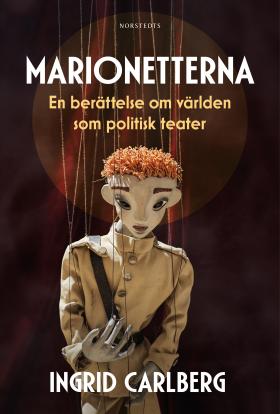
Marionetterna
Norstedts, 2023
Foreign Rights: Brave New World Agency
We are grateful to Norstedts for their permission to publish this extract.
Ingrid Carlberg is a journalist and non-fiction writer, who, since 2020, has held a seat in the Nobel Committee of the Royal Academy in Stockholm. In 2012 she was awarded the August Prize for her biography of the diplomat, Raoul Wallenberg.
Ian Giles is a literary translator who has more than 40 published titles from the Scandinavian languages into English to his name. He is currently the Chair of the Translators Association and was elected to the Society of Authors’ Management Committee in 2025.