
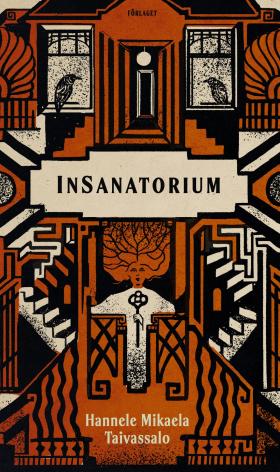
InSanatorium
(InSanatorium)
By Hannele Mikaela Taivassalo
reviewed by Margaret Dahlstrom
Hannele Mikaela Taivassalo is an award-winning Finnish author and playwright, who writes in Swedish. InSanatorium, her seventh novel, is a short but powerful work which addresses the need for security and companionship in the recovery of mental and emotional well-being. The sanatorium itself is introduced before the reader meets any of the characters. The building is rundown and abandoned-looking, set at the end of a dead-end street. From the outside there is something Gothic about it, with its flaking paint and ravens on the roof. But inside it’s more welcoming and has a muted friendliness about it - described as a hotel occupying a place somewhere between dream and reality. Yet, in spite of a dreamlike quality in the narrative, there is also a stark awareness of the reality of the situation...
The protagonist is Ali, a young woman profoundly affected by an apparent trauma, but the nature of this trauma is never revealed. Indeed, Ali herself seems not to remember much of her life before reaching the sanatorium. She reflects that she had been trying to exist until that was no longer possible. She has no will to live but doesn’t know how to die. She arrives with only a key on a chain around her neck, and her grandmother’s clock. Her few memories include a building before this one, and a white room in it, suggesting a hospital, which might mean this ‘hotel’ is a rehabilitation centre or halfway house.
The building has several floors with a number of residents on each, but the reader meets only a few. Rina, a colourful character whose behaviour is sometimes confronting to the other residents, starts to mother Ali and they become close. The unnamed Violin Boy also befriends her. The support of these friends helps Ali in her recovery, and the carers Toso and Hertha ensure that she eats and drinks, and takes an (unexplained) daily pill.
Ali gradually responds to the company and the care, and in her turn provides support to the others. It is not all progress; Ali and her friends have set-backs, but the atmosphere and tranquility of the place are conducive to positivity and recovery. For Ali, the street cats which she helps to feed, and the ravens which she observes from her room, are also significant in the daily life and routine of the sanatorium.
The characters are seen only in their current context. The reader learns nothing of their lives before and outside the sanatorium. This gives a sense of timelessness to the narrative. Ali’s grandmother’s clock is all that indicates that time is passing. This is perhaps a factor in the noticeable absence of pressure on the residents. This is not an institution that requires a strict adherence to schedules.
But there are dark undercurrents which suggest a less optimistic reading. The Gothic sense of the early pages never really completely lightens. It is possible that this is not a halfway house, but the end of the line. The unexpected and perhaps unlikely tranquility may be produced by the daily pill – the reader sees only Ali provided with this but perhaps the other residents have something similar. Although it’s referred to as a hotel, there is no sense of transience. On one occasion Ali wanders into the street but Toso gently brings her back inside. She senses the doors monitor movement, and this both frightens and reassures her: the building shuts them in, but also shuts the world out. To me, there is a Hotel California vibe: “… we are programmed to receive/ You can check out any time you like but you can never leave”.
However the reader interprets the text, this is powerful writing and a very moving narrative. The importance of human connection and mutual care are crucial to the survival of the characters, whether or not they fully heal.

InSanatorium
Förlaget, Finland, 2026. ISBN: 9789523336872. 172 pp.
Foreign rights: Rights & Brands.
Hannele-Mikaela Taivassalo has won the Runeberg Prize (2007), Finlandspris (2017) and the State Prize for Literature (2024). Other works include In Transit (reviewed by Claire Dickenson in SBR 2017:1), Scandorama (reviewed by B.J. Epstein in SBR 2019:1-2).