
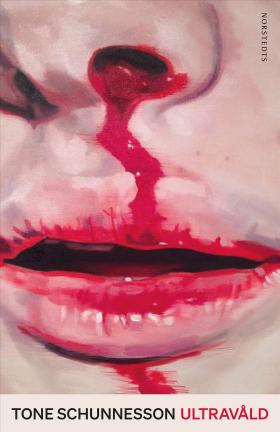
Ultravåld
(Ultraviolence)
by Tone Schunnesson
Reviewed by Emma Olsson
‘Ultraviolence’, a term coined in Anthony Burgess’s A Clockwork Orange and further popularized by the Stanley Kubrick film, refers to violence in its heights of excess; violence to the point of intoxicating thrill. It is violence with an aesthetic, like a Quentin Tarantino film. For Schunnesson’s characters, it is a state of apathy that allows them to detach from reality, to feel as though they are existing outside of their own ugly human bodies.
Schunnesson’s novel follows the members of the Griepenbrand family: mother Monica, father Carl-Fredrik, little sister Eddie and big brother Jarl, who appear to be tied together not only by blood but by a bloody fate. Carl-Fredrik is the layabout son of a noble family who bequeath him a dilapidated castle in the south of Sweden, keen to keep him and his dysfunctional wife and kids out of the family business. Being cast away not only by their own blood but also by the regular townsfolk – who unsurprisingly take a dislike to the weird family occupying the decaying manor – the Griepenbrands develop an air of isolation that seems to haunt them wherever they go. When Carl-Fredrik goes missing and is suspected dead, it is only the start of this family’s suffering.
How each member of the family deals with this tragedy forms the novel’s central pulse. Jarl blossoms into a beautiful young man, comes out of the closet, and achieves early success as an indie filmmaker which leaves him irrevocably jaded and self-involved by his thirties. Eddie is desperate to fit in at school, find a boyfriend and lose a few pounds, and remains in a state of arrested development as she ages. Monica, catatonic for years after her husband’s disappearance, has a hilarious come-to-Jesus moment that changes the family’s trajectory for good. Dipping in and out of these three perspectives is thrilling and compulsive.
One of the themes Schunnesson seems most invested in is the question of violence and pop cultural aesthetics. Moving images, music and fashion both inform the world of the characters and mask its reality. Reality can be mundane. Eddie and Jarl would rather decorate theirs with beautiful distraction. They are disconnected from the world around them, as though they themselves are living in a film.
Schunnesson’s aesthetic eye is defined and meticulously developed. The novel is littered with references to Y2K culture, from Jarl’s adoration of Woody Harrelson in the film Natural Born Killers to Eddie’s g-strings and 90’s style hair crimper. There is a kaleidoscopic, multi-media effect to the novel that recalls the saturation one might have felt while flipping through the TV channels twenty-five years ago: the impressions of a music video, Hollywood movie and mind-numbing commercials intermingling in one’s subconscious. Jarl and Eddie are the ones in control of the remote, choosing the images that appeal to them, and using them to craft their own worlds. They make meaning from a finely-curated aesthetic. It is what lies below the surface that challenges them.
Even the titular violence of the novel feels reminiscent of an earlier era, emitting a distinct Gen-X coolness in the vein of Brett Easton Ellis. But in contrast to Ellis, whose novels such as Less Than Zero and American Psycho have come to exemplify the moral rot of the MTV generation, Ultraviolence is undecided on its position. There is an ongoing tension between apathy and sentimentality. When a character comments negatively on Jarl’s breakout film, disparaging it for whining about having a mean mother, Jarl takes great offense. He rejects sentimentality with his whole being, he says, but still, ‘he knew there was a touch of it in the film, and that it was that touch that had gotten him selected for Sundance.’
I get the sense that Schunnesson delights in this juxtaposition, the cool versus the sappy. It’s a condition she thrives in. Her previous novel, 2020’s Days, Days, Days (translated to English by Saskia Vogel), depicts the existential crisis of an aging influencer and delights in the tension of high-low. Ripe with incisive questions about truth and meaning-making in an age where capital can be extracted from self-image, the novel also features a detailed scene of the main character having jalapeños and cocaine-induced diarrhea, to name just one passage that foregrounds the bodily and the icky.
Schunnesson discusses her penchant for the indecent in a recent interview for Dagens Nyheter. ‘It’s a perverse trait of mine, that I’m drawn to the violent and the gross. I find enjoyment in trying to depict it in writing or thinking about it. Maybe because I find it hard to access in my real life.’
I would certainly hope that the violence depicted in Ultraviolence does not get attempted in real life. I’ll find comfort in the knowledge that it’s only a story.

Ultravåld
Nordstedts, 2026. 440 pp. ISBN:
Foreign rights: Norstedts Agency
Schunnesson was also interviewed in SBR 2025:2 : The fluidity of a city can be very overpowering, both to write and experience.'
Her first novel, Tripprapporter, was nominated for the 2016 Borås Tidnings Debut Prize.