
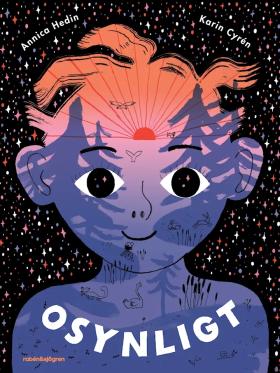
Osynligt
(Invisible)
by Annica Hedin and Karin Cyrén
Reviewed by Elizabeth Lutz
Try to list a few things that are invisible, and you might immediately think of the air in a balloon, the sound of laughter, or the smell of cinnamon buns. But what about your name? People use it, but is it really seen? Or the fact that the girl walking past your house right now can do a handstand. How would you know it? This book doesn’t just list things that we typically can’t see with our eyes; it also poses questions about what these things even are. What is it that gives us goosebumps when we sing together? What is the warmth of a hand holding yours on the walk home?
The book is narrated from a child’s perspective. The child is curious and observant. Their questions begin with ‘I’m thinking about…’ and can encourage discussion among readers. What makes jam taste so good? What is the creepy feeling you get when you read certain books? At other times the child offers simple but resonant statements: ‘No one can see that I want to go home. But I do.’ Hedin’s text is just under 200 words and is thoughtfully arranged to prompt readers to pause at certain moments. The pacing leads perfectly up to the book’s core, where it shifts from talking about the physical heart pounding away within your body to people who have died—specifically, the child’s grandpa. Yet it does not turn sentimental. The child only states: ‘This is still his cap. He is still my grandpa.’ Distinct from a few of Hedin’s other books (such as Det som känns förbjudet - ‘Things that feel naughty’ - reviewed in SBR 2023:2), it is much less pedagogical in tone. There are no ready answers provided here.
Cyrèn uses a combination of bright and dark colours in the illustrations. There is a difference in colour between home and school settings, with shades of reds and purples as the tone for home, while greens and yellows are used for school. She incorporates transparent pages into the design by layering. Elements of the whole are scattered among several layers of paper. Often objects are hidden in one spread and revealed in the next, as if invisible things could be similarly discovered by the turn of a page. Details in the child’s room reinforce the impression that the child has scientific leanings. A poster of the solar system hangs on the wall. The bedspread and pillows are decorated with a graph-paper type square design. The child even has large eyes and ears.
A main strength of this book is that it does not attempt to offer answers to the child’s questions. Instead they are left open for interpretation from the audience. The child is not given a specific gender and their school, family, and neighbourhood are general enough to be easily relatable to many readers. What Hedin’s text and Cyrén’s illustrations do together is to promote curiosity about these invisible things, giving valuable attention to what may go unacknowledged because it is not seen. I hope we can look forward to more picture books from this creative team.

Osynligt
Rabén & Sjögren, 2025. 56 pp. ISBN: 9789129744224.
Rights: Koja Agency.
Annica Hedin has written several children’s books in collaboration with illustrators such as Karin Cyrén, Hanna Klinthage and Per Gustavsson. In 2022, she received the Lennart Hellsing Scholarship.
Karin Cyrén is an artist who won the 2019 Snöbollen Prize for Best Picture Book with Maraton (Marathon). Osynligt is her second book with Annica Hedin.