
from Nowhere Land/Women in Revolt
by Monika Fagerholm
translated by Bradley Harmon
Monika Fagerholm – one of Finland’s most internationally acclaimed authors – returns with a hypnotic novel about growth and creativity against a background of latent violence. The first part in a new trilogy, the novel follows Alice, a young woman coming of age in the late seventies, as she moves from claustrophobic Finnish backwater to leafy city suburb, from childhood to writing life. Told in an impressionistic, digressive style that circles back and forth over itself, constantly editing or complicating its progression, Fagerholm brings into relief the looming spectres in peacetime society as Alice finds her creative footing in the rich cultural milieu of the age.
This excerpt, taken from near the start of the novel, shows Alice at the beginning of her journey. Savouring her first taste of adult freedom, Alice has just decamped to a cabin at the end of her garden away from her mother, Frieda and sister, Lilija, and started work in the local kiosk. But an encounter with the enigmatic ‘Honecker’ (nicknamed after the GDR leader) will upturn those quiet summer plans – not to mention the trajectory of her future life.

from Nowhere Land/Women in Revolt
Fragmented Nights (June 1976)
That’s how she makes her entrance, Honecker. The kind of person who shows up out of nowhere on those late, incandescent nights. Honecker, who isn’t yet ‘Honecker’: that name, after an eternal leader of the GDR with a fondness for long, dreary ideological speeches, will be bestowed on her a bit later when she’s a student at law school, where, to Alice’s surprise, she’ll all of sudden be enrolled.
For now she’s just another young woman from the local nightlife who’s more or less the same age – not from these parts, but she has relatives here that she visits during school breaks. Except: ‘during school breaks’ doesn’t actually apply in Honecker’s case, at least not this year. She arrived much earlier, when school was still in session. And who’s that sidekick, the American, who’s always with her? Timothy?
This is what Alice knows about Honecker so far: according to rumours that will only partly hold up, Honecker has just been expelled from a private boarding school in a neighbouring country and that’s why she arrived earlier than usual, already in mid-May, in the company of a man called Timothy, her American boyfriend who isn’t her boyfriend, just a kid who was an exchange student at the school she went to. An immediate rapport sprang up between them. They discovered they were kindred spirits, the same kind of devil-may-care creatures, to such a degree that when, due to certain events at the school, the time came for Honecker to leave and, as part of the punishment enforced by her family, take the ferry to the neighbouring country and to summer lodgings on the outskirts of ‘our little town.’ It was obvious that Timothy would leave himself behind at the end of the exchange year. That is, not return to his home country like the other exchange students, and instead take the ferry across the bay with Honecker so they could lie on deck in their insulated sleeping bags from the army surplus and gaze at the stars and yada yada… Alice buys into all sorts of nonsense, truly believes – perhaps for the simple reason that she wants to believe. She ‘needs’ such thrilling stories to survive the tedium – to survive at all, to put it grandly – in the absence of her best friend Bijou, who’s de facto left her, ‘I can’t bear the sight of you anymore,’ just turned on her heel and walked away. Very Bijouesque, indeed. Though she, Alice, doesn’t want to or can’t admit it yet, she has a real hang-up about Bijou (whom she’ll forget about in a few seconds, as soon as Honecker steps onto the stage and becomes a real, living person for her).
So that whole story about Honecker’s life before she came to the village, that thing about Timothy the exchange student, would turn out to be charades and lies, at least the important parts (there would be a version, to be sure, with a grain of truth in it, but only a measly little grain). It would be told that way because it needed to be told that way, because the reality couldn’t be revealed. The truth would emerge in dribs and drabs, over months and years, but Alice would become a writer in the process, and Honecker and Alice would become friends, and the friendship would last for life.
But to avoid complicating this now, and not beat too much around the bush, it can be said right away that Timothy is not the Timothy he’s presented as. And Honecker, well who the hell is she, really?
Then again, it’s not truth that Alice needs here now in this quiet village, but some kind of contact with that restlessness and energy crawling aimlessly around inside her. A kind of SPACE/PLACE where you can cast off together. And that’s what they find almost immediately, she and Honecker: a SPACE/PLACE where they can break free together.
So, sparkling together in the night, they show up, in early summer 1976, Honecker and Timothy, with the disco ball. Quite literally: they have the ball with them. At the tail end of an obscure little entourage that, after closing time, heads to the cabin on her mother Frieda’s property where Alice has been living for barely a month and a half, in purposeful solitude away from her mother’s farm and younger half-sister Lilija on the other side of the field.
When the lights went out above the dance floor at the pub, Vixen, which is what the village’s summer disco is called that year, they unscrewed the disco ball from the ceiling and solemnly set it down on the table like a trophy, where it reflects cigarette butts and candles jammed into empty wine bottles, and then lift it carefully toward the ceiling to hook it into a rust-eaten metal loop that can’t bear the weight.
The ball drops to the floor and shatters into thousands of sharp shards of glass. Crash, shards everywhere, Honecker just laughs, but Lilija (who of course is there) is there with broom and dustpan, while Alice, at the very moment this happens, is already up on the bunk in the sleeping bag into which he, Timothy, ‘call me Tim,’ has already crawled. ‘I’ve been waiting for you my whole life,’ he says. It sounds convincing, but above all glitteringly juvenile, irresistible, so now they, Timothy and Alice, will enter, not against Alice’s will, into an affair that will bring her to one of those Honecker-ish archipelago islets as one in a seductive trio, Timothy–Honecker–Alice, and then end abruptly on Midsummer Day with an interlude that climaxes, fittingly, with Timothy – a man of gestures – jumping into the water at Alice’s provocation oh fuck off, go jump in the sea. And swimming back to the mainland to mark the full stop of the argument and to hell with it, Alice will think without regret as she watches his dark head become an ever-smaller dot against the backdrop of Church Bay in the bright summer evening. And afterward Honecker and she will stay on the islet, the two of them, for almost a month – three and a half weeks – until, at the end of July, Honecker badly sprains her ankle and they have to bring the homecoming forward and Honecker’s grandfather has to hurriedly take them back to the mainland.
With a cabin-building project permanently half-finished, on gradually sunnier days, because this summer takes its time getting started, but when it does, it’ll be hot: hopping into the sea from warm rocks and orange wine in canisters and spaghetti and cheese and ketchup for lunch and cheese and spaghetti and ketchup for dinner, and The Adventures of Augie March, the book Honecker is reading: Thea had perfect life.
And what do she and Honecker become? Not best friends. Or anything of the sort. Not at all inseparable, they each have their own wavelengths, but they share an energy that coincides and conjures more of itself when they’re together. They like hanging out and chatting on the same frequency – dreaming together. Synchronized dreaming for a few summer weeks, just the two of them, out on the islet, in a sort of symbiosis that both know, without needing to say it, applies there and then, under only those circumstances.
But they do have things in common, things they’re both interested in.
Like, during those last summer days before they part for good (not for life, but it’ll be a long time before they see each other again, or have contact), heading down to the riverbank, drinking beer, and talking. The two of them, or – because Timothy turns up again – the three of them.
They don’t share secrets, or at least not many – Alice had enough of those with Bijou…she’s fed up to the gills with it. Or maybe that’s not it, not the reason why: the fact that even after the summer Honecker will still be a question mark when it comes to her personal affairs, relationships and the like, the sort of thing you assume you find out when you build a friendship and thus form a picture of who she really is. With Honecker: you form no such picture, just begin, jump right in.
And that’s how it ends too: in the middle.
But let’s not get ahead of ourselves. It’s still the beginning of summer.
Already by the next afternoon – that is, after the night with the disco ball and Timothy, whom Alice left in the sleeping bag in the cabin when she crawled out bright and early after maybe two hours’ sleep, after she made it to the kiosk down by the same riverbank – Honecker turns toward her grinning, that is, smiling wide and expectantly: ‘What’re you doing this summer?’ It’s like a movie, Alice thinks, having come ambling along in Timothy’s wake – he, or ‘Tim,’ as she’s now meant to call him, had been waiting for her outside the kiosk when she got off work – ‘come,' – and hauled her off to a decisive meeting at the riverbank where Honecker, in sunglasses, lay sprawled out on a blanket in the sun with a book.
‘What’re you doing this summer?’
And Alice senses, instantly, as if by instinct (for she is suddenly empty-headed, but empty in a good way; ‘whatever I want,’ she wants to shout with a kind of childish enthusiasm entirely unsuitable for the moment) that this is a question that should, must, be answered vaguely. Evasive, because Honecker perhaps has something in mind.
Something that can’t be overlooked. Alice realizes as well, she notices it with a pounding heart even if it neither shows nor can be heard, that is, she’s supremely cool – cool, yes, her hallmark in ‘our little town,’ a hallmark she’s guarded and guarded like a fool, like some kind of shield, ‘it’s the only thing I have,’ and yet not worth a damn. She understands that too, in this precise moment on this promising summer day, groggy after a complicated night with Timothy (who is where? She looks around. Certainly not next to her; it’s just her and Honecker, for Timothy has, quite simply, left them to themselves for this meeting). Making her way home from the summer job which, hand on heart, is what she’s going to ‘be doing’ this summer, a prospect that seemed perfectly decent up until this point, she mumbles something vague and evasive about the summer job, and Honecker raises her eyebrows for a few seconds, then decides:
‘Your dreary sister can take care of that.’
Her dreary sister. THAT is music to Alice’s ears; she smiles even wider. And just then Timothy reappears.
‘She’s coming,’ Honecker says to him in English.
‘Where?’ Alice asks.
‘Out here to the archipelago. Not to be boy and girl,’ she adds, for Tim’s benefit, Tim who’s put an arm around Alice, ‘but to work.’
To work. That’s what Honecker has to offer. Another summer job. Out in the archipelago.
‘We’re not boy and girl,’ Alice mutters, but Timothy just chuckles.
[…]
Perfect Life?
It’s felt this way for a while, even if that really isn’t the point, or a question under scrutiny, so to speak, during those summer days when Alice is lying on her back and looking into the sky. No reading, no thinking, no writing, instead intent only on absorbing, savouring. Dwelling in the dream of what Honecker offers up, in words, thought, action, and perfect intoxication. There’s a kind of intoxication that needs no alcohol. It’s an energy: a tiger asleep before the leap…or Thea, who trained birds of prey in Saul Bellow’s novel and perhaps for that very reason – her strength, her defiance, her drive to go her own way – was impossible to live with (according to Augie, who couldn’t keep up and left her in the end).
With Honecker all this made perfect sense –
A new energy. And stripes of meaning.
NOW, in this enormous young NOW: the sun, the rocks, and Honecker talking about how she’s going to start writing. ‘Become a writer?’ Alice chimes in. Honecker looks at her impatiently as the sun climbs across the sky, hotter and hotter, burning them red until blisters break out on their skin and they have to smear themselves with Nivea at night. ‘I will write, I’m telling you, I will and WANT to be a reading and writing person – it’s not…a profession, it’s a conscious practice, a way of being in the world.’
And Alice repeatedly imagines Honecker in the room she talks about, which she read about in the diary of the French writer André Gide: he had once climbed up to an attic in Paris with a view that stretched straight out over the rooftops and all the way up toward the heavens, and imagined a table in front of the window and on it his typewriter with a blank white page ready and waiting. And dreamed of staying there and writing the novel he wanted to write. And only coming down when it was finished, from beginning to end. When the work was completed, as he wrote in his diary.
It is to such an attic room that Honecker says she will retreat when the summer ends, to write, to read. To become a reading and writing person. That is what she will do with her future, Honecker. And she says it in just those words: ‘My future.’ And: ‘My freedom.’ And to these words Alice dozes off, like a kitten: a kitten that might, perhaps, one day be a tiger, a jaguar.
Otherwise she’s rather quiet, realizes suddenly that she doesn’t have much to say.
Though it’s not necessary.
For yes, in those moments they had it, she and Honecker. Perfect Life.
She remembers the sun, remembers the sea, remembers a dog that one of the cousins had brought along, remembers this and that, and then suddenly it’s dark and it’s autumn and she’s living in a rowhouse in another city – in the guest room.
That summer changes everything – and then that’s that.
Alice searched the whole islet in the rain and found Honecker in a crevice.
She had fallen, twisted her ankle. Can’t walk.
Alice has to try to get hold of Faffe to come fetch them.
She gets hold of Faffe. He comes and fetches them.
Honecker, my friend. Honecker and Alice, in the beginning, the summer of 1976, drawing toward August when they would part and everything would change. They didn’t become inseparable, as mentioned, they wouldn’t be a part of each other’s lives after this. Both are far too unfocused for that, heading in different directions, Honecker to that attic to write, or whatever she would do, staying until she was finished with what she had to finish, not to become something, but to be, it’s a conscious practice, a reading and writing person, in the world.
It was beautiful, of course. Alice was moved, also by Honecker’s way of talking about literature, something she’d never thought about before in her life, literature as a state: of thoughts feelings ideas utopia and reality coinciding, into one and many voices coming near, breathing down your neck.
‘And what about me?’ Alice would think during sweaty nights in such states of mind with a pounding heart, leafing through The Gay Science, energy meeting energy, heading ‘into the eye of the storm’ (but first to the edge of the storm, where was it?).
So, to put it another way, plainly: the goal wasn’t to live out the daily life and challenges of the bourgeois nuclear family in her father Max’s house in a row of houses in the suburb fifteen kilometres outside the capital, where she decided at summer’s end to move to, and like a cuckoo chick wedge herself into her father’s new family (mother, father, and two sons). There were no conflicts; she had an open invitation, and she liked Siri too, her father’s new wife (really his only wife, since he and Frieda had never been married; he’d been a village boy, from messy circumstances but immensely gifted, who after a spell at sea, just nineteen years old, sought refuge with Frieda, who was a bit older, thirty-one, and for a short time between the older woman and the younger man there had been a sexual intimacy that produced, well…Alice, along with a lifelong mutual friendship and loyalty between Frieda and Max).
And Siri likes her.
Green lawns, yellow sun umbrellas – and even though she admires her father so boundlessly that she could hardly show it, it wasn’t for that reason either, not because of that feeling – but because she thinks she needs a platform, a base, somewhere to spring from.
And so she came to realize, during those summer days: it was impossible for her, after Honecker, to stay here in this place, living daily life and going to school as if nothing had happened. After this summer, these experiences, she had to leave NOW, and a week after her return to the mainland she was standing in the phonebooth outside the library in the middle of the village, dialling Max’s number, and letting him know that she was on her way.
Breathless, as if life, her entire life, depended on it.
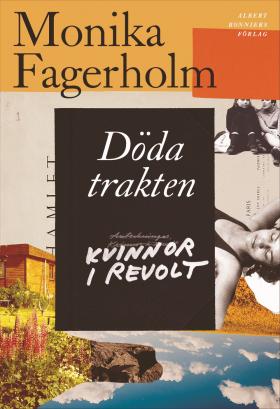
Döda trakten/Kvinnor i revolt
Förlaget (Finland), Albert Bonniers förlag (Sweden), 2025, 384 pages
Rights: Salomonsson Agency
We are grateful to Monika Fagerholm and Salomonsson Agency for granting permission to publish this translated extract.
Winner of the 2026 Runeberg Award and the 2025 Finlandia Award.
Monika Fagerholm is a multi-award winning Finland-Swedish author, regarded as one of Scandinavia’s finest literary authors. This novel was reviewed by Darcy Hurford in SBR 2025:2, and an extract from her 2012 novel Lola uppochner (Lola Upside-Down) was published in SBR's 2013 Special Issue on Finland-Swedish writing.
Bradley Harmon translates from primarily Swedish and German. His recent and forthcoming book translations include poetry by Johannes Anyuru, Katarina Frostenson, Lív Maria Róadóttir Jæger, and Esther Kinsky; fiction by Monika Fagerholm and Eli Levén; and biographies of Avicii and Björn Borg. He lives between Baltimore and Berlin as he completes a PhD on the ecopoetics of flesh in German and Scandinavian poetry.